Average Cost to Remodel Master Bathroom: What You'll Pay
Average cost to remodel master bathroom ranges from about $10,000 to $35,000 by scope. See budgets for refresh, midrange and major projects in 2026.
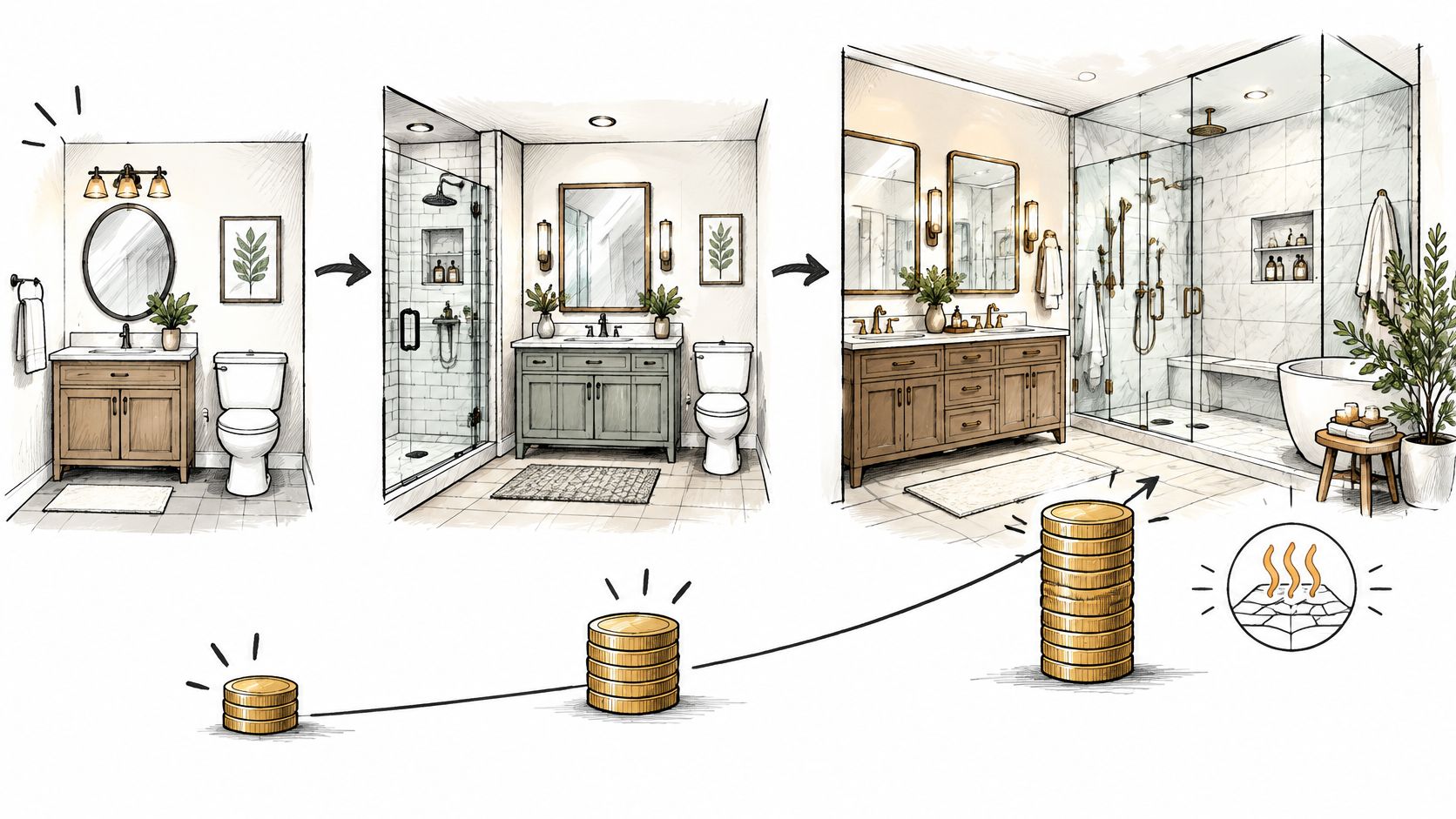
The average cost to remodel a master bathroom in the U.S. is roughly $10,000 to $25,000 for an existing room, while a midrange primary-bath remodel is better benchmarked at about $18,000 to $35,000. Both ranges are starting points rather than bids.
Say you're standing at the vanity, looking at a peeling cabinet door and a shower that never quite feels clean. You want fresh tile, better storage, and lighting that doesn't make getting ready feel like an interrogation. Then someone suggests moving the shower, and suddenly your bathroom update has become a construction project.
That's where budgets split. Changing what you see, replacing the whole room, and changing how the room works are different jobs. A useful budget starts by choosing which job you want, then leaving enough room for what demolition might reveal.
Master Bathroom Remodel Costs at a Glance
Start with the room you have, not the bathroom you saved on your phone. Is the layout comfortable? Does the shower leak? Are you replacing tired finishes, or trying to solve a daily traffic jam around the vanity?
For renovating an existing master bathroom, HomeAdvisor's bathroom remodeling cost guide gives a national planning benchmark of approximately $10,000 to $25,000, with project-specific estimates often clustering near $125 per square foot. Its surface-refresh range is roughly $1,000 to $3,500, while complete tear-out and replacement is commonly cited at $5,000 to $15,000, before premium finishes or major layout changes.
Master bathroom remodel cost by scope
| Scope | Typical cost | What it covers | Reference point |
|---|---|---|---|
| Surface refresh | $1,000 to $3,500 | Paint, lighting, and fixture replacement, with plumbing staying put | HomeAdvisor's cosmetic-update benchmark |
| Full tear-out, same layout | $5,000 to $15,000 | New tile, shower, vanity, and toilet in existing spots, before premium finishes | $10,000 to $25,000 national planning benchmark for an existing master bath |
| Midrange primary remodel | $18,000 to $35,000 | Defined scope with mid-grade finishes and drains kept near existing positions | $26,138 average for a defined-scope midrange project |
| Large primary, major remodel | $25,000 median | Shower work, vanity, countertops, and toilet replacement | For rooms at least 100 square feet, the upper-end spending threshold reaches $70,000 |
| Luxury primary remodel | Priced by scope | Custom tile, heated floors, frameless glass, and dual vanities | Upper-end major-remodel spending is a comparison point, not a luxury price schedule |
For the size-based rows, the 2025 U.S. Houzz Bathroom Trends Study reports a $25,000 median for major renovations of primary bathrooms at least 100 square feet in 2024, with the top 10% spending at least $70,000; the equivalent upper-end threshold for smaller major remodels was $45,000. Those are spending distributions, not promises about what a particular finish package costs.
Choose by work, not appearance
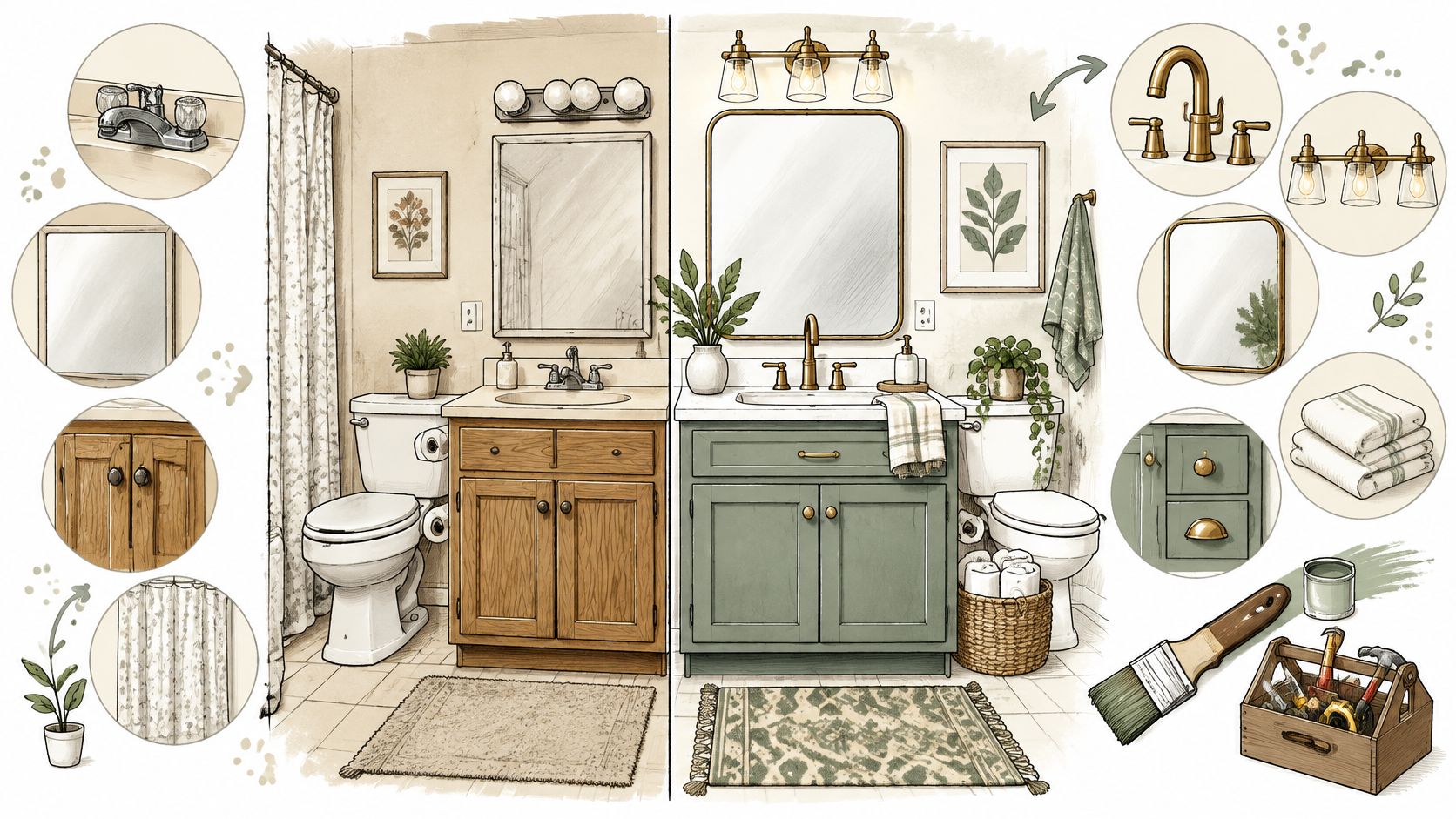
A refresh suits a sound bathroom with dated styling. Paint the walls, replace the light fixture, and change the faucet without opening the shower assembly.
A full tear-out suits a bathroom whose arrangement works but whose components don't. The room may look completely different afterward, even though the toilet hasn't budged.
Midrange and custom projects require closer specification. A stock vanity and straightforward tile installation aren't interchangeable with furniture-style cabinetry and a shower covered in carefully aligned mosaics.
To choose your tier, write down what stays, what gets replaced, and what moves. If drains or walls move, don't use a cosmetic-update budget just because the room is modest.
Why One Average Hides the Real Price
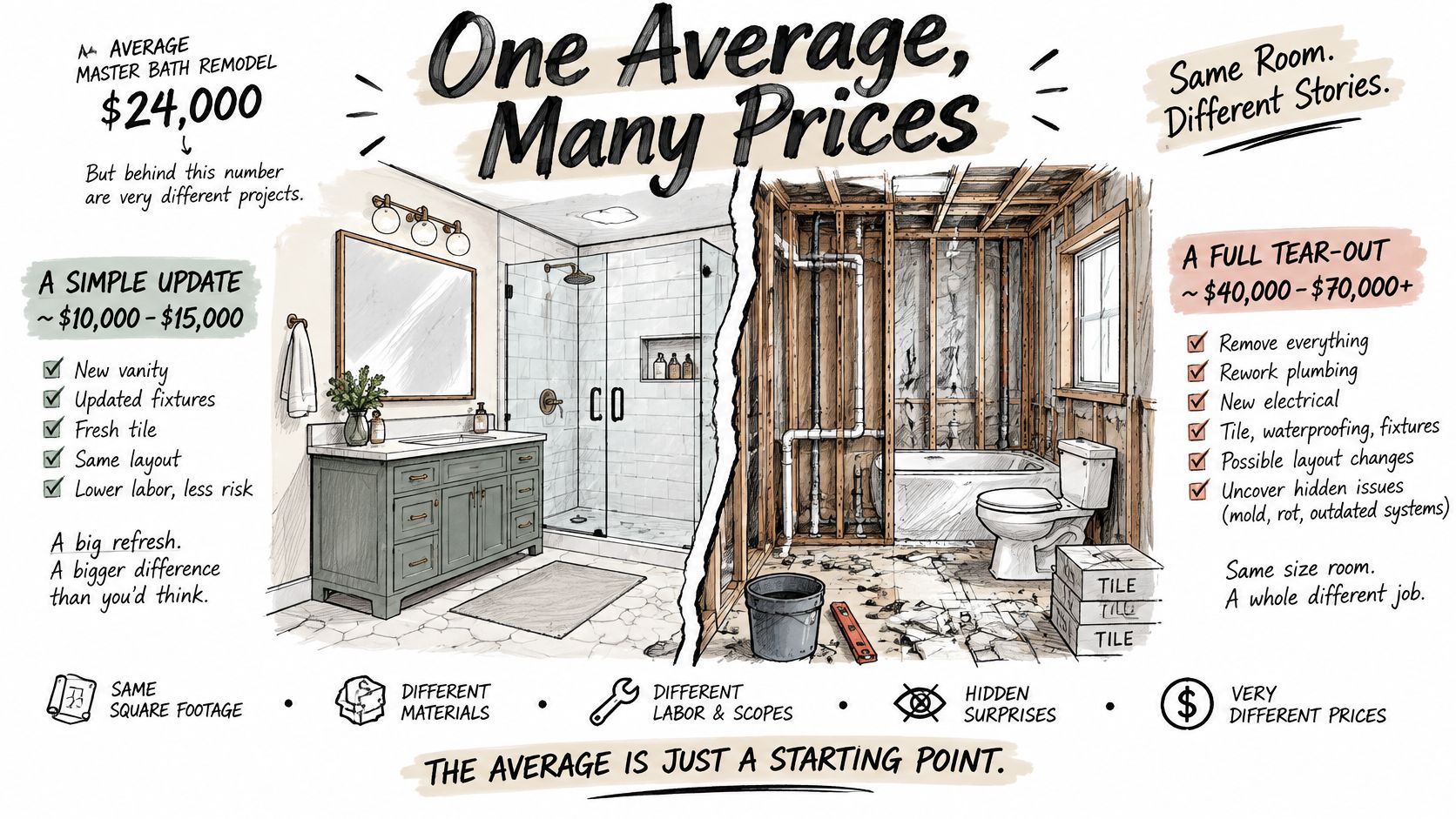
A headline average can be accurate and still be useless for your bathroom. It's a bit like pricing a used hatchback and a pickup together because both qualify as vehicles. The category is technically correct; the shopping advice isn't.
In its 2021 housing-improvement data, Harvard University's Joint Center for Housing Studies reported average spending of $6,748 across professional bath remodels, compared with $23,557 for professional major bath remodels, defined as projects exceeding $15,000. The difference is scope, not a secret discount available to everyone except you.
The projects hiding inside the average
- Cosmetic refresh: You keep the functioning shower and floor, update visible fixtures, and improve the room's appearance.
- Full fixture replacement: You remove worn components and rebuild the bathroom without substantially rearranging it.
- Structural or luxury renovation: You change the layout, relocate services, specify custom cabinetry, or add features that require supporting construction.
Say you want to remove an unused tub and put the shower there instead. That isn't just a shower purchase. Someone must work out the drain arrangement, prepare the new wet area, address the abandoned connections, and coordinate the surrounding finishes.
A smaller room also isn't proportionally cheaper. A compact bathroom still needs a shower valve, toilet, vanity, waterproofing details, and the tradespeople who install them. Less floor tile doesn't eliminate those tasks.
Before trusting an average, ask what work the homeowner actually bought.
That question matters especially in Orange County and Los Angeles, where a national historical benchmark can't account for your property's access, existing conditions, or local construction requirements.
When a search for the average cost to remodel a master bathroom produces a surprisingly reassuring number, test its category. Does it describe all bathroom projects or major renovations? Does it include plumbing relocation? Is it an average expenditure, a median, or a standardized estimate?
The right comparison isn't the lowest published number. It's the project most like yours.
Where Master Bathroom Money Goes, Trade by Trade
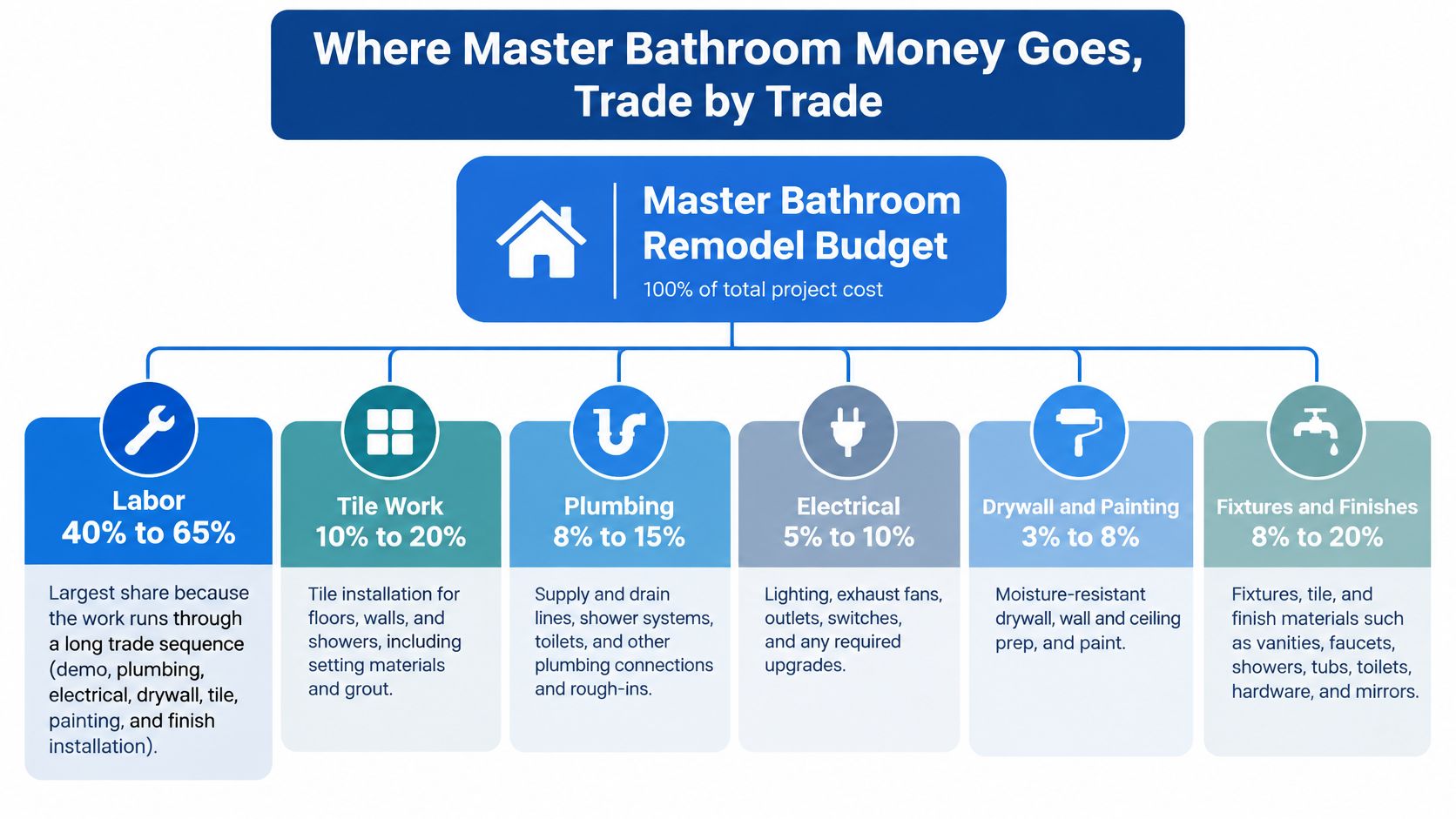
Labor can cost more than the beautiful things you'll photograph afterward. A Boise Bath guide summarizing bathroom remodeling cost benchmarks places labor at approximately 40% to 65% of total spending and describes a midrange primary-bath planning range of $18,000 to $35,000, alongside a nationally reported defined-scope project averaging $26,138.
That standardized project explains the midrange reference in the cost table. It doesn't turn a larger room with custom cabinetry into the same job.
Why a small room needs so many trades
The construction sequence usually includes:
- Demolition: Remove finishes and fixtures while protecting adjacent rooms.
- Rough plumbing and electrical: Install concealed connections before closing walls.
- Wall preparation: Correct framing and provide suitable backing and substrates.
- Waterproofing: Build a continuous water-management assembly around the shower.
- Tile installation: Plan the layout, make cuts, set tile, and finish joints.
- Cabinetry: Fit and secure the vanity and storage.
- Glazing: Measure and install the shower enclosure.
- Finish installation: Connect fixtures, install trim, paint, and complete adjustments.
These aren't independent errands. The tile setter needs a prepared substrate. The glass installer needs finished dimensions. The plumber needs the correct valve and trim combination, not just a faucet that looked nice online.
Save on decoration, not the shower assembly
Say the shower looks expensive, but its niche has poorly detailed corners and its base doesn't drain correctly. Water can reach the framing even while the face of the tile looks perfectly respectable.
Tile and grout aren't substitutes for a waterproofing system. Proper slope, membrane continuity, drain connections, and penetrations matter because repairing a concealed failure can mean removing finished work to reach it.
Plumbing location creates another coordination cost. Keeping shower and toilet drains near their existing positions generally avoids some concealed rework. If relocation would improve the room, examine the cost to move a toilet before treating it as a minor layout adjustment.
A weak estimate often looks attractive because it leaves difficult work undefined. If the floor beneath the shower is soft, a tiny repair allowance won't make the repair inexpensive. It merely postpones the budget conversation until the old tile is gone.
Spend less on an elaborate tile pattern before spending less on what keeps water out of the framing.
Coordination matters, too. At Epic Remodeling, our Interiors service covers flooring, painting, carpentry, electrical, and plumbing. Putting those scopes under a coordinated schedule helps reduce handoff delays and gives the homeowner a clear place to bring questions when one trade's work affects another.
Renovate or Expand, and What Each Costs Back
The resale comparison favors renovation over new square footage in the 2024 Cost vs. Value study covering 150 U.S. markets: its standardized midrange bathroom remodel recouped 73.7%, compared with 34.7% for a midrange bathroom addition. The study's corresponding job-cost and estimated-resale figures are shown below.
Midrange bathroom remodel versus addition, cost and resale
| Project type | Average job cost | Estimated resale value | Cost recouped |
|---|---|---|---|
| Midrange bath remodel, existing footprint | $25,251 | $18,613 | 73.7% |
| Midrange bath addition, new square footage | $58,586 | $20,334 | 34.7% |
These figures describe standardized midrange projects, not every primary bathroom. They're a comparison tool, not an appraisal of your house.
An extra room is more than extra tile
Say your bathroom already has an oversized tub, an awkward vanity, and enough floor area for a generous shower. Replanning inside that envelope is a different proposition from pushing an exterior wall into the yard.
An addition may involve foundation work, new framing, roofing, exterior finishes, and connections between old and new construction. You're buying building space before you begin choosing the bathroom finishes.
Our Additions service includes ground-up construction and room additions. When new space is necessary, we treat that construction scope separately from the interior bathroom selections so the distinction remains visible.
Buy daily usefulness without assuming full repayment
Use these decision rules:
- Prioritize the problem you live with: If storage and shower access are the frustrations, spend there before adding decorative features.
- Choose premium items deliberately: A shower control you use every morning may matter more than an elaborate wall treatment behind the toilet.
- Separate renovation from expansion: Price the existing-footprint option and the addition as distinct scopes, rather than blending them into a vague bathroom budget.
Resale estimates don't mean a remodel is a bad purchase. A room that's easier to clean, more comfortable to use, and better suited to your household has value while you own the home. Just don't treat personal enjoyment as guaranteed money back at closing.
If the existing room can accommodate the function you need, investigate renovation first. If it can't, budget the addition as a construction project with its own design and estimate, not as an upgraded version of a fixture replacement.
Budgeting for Overruns and Temporary Living
A reassuring midpoint doesn't protect you from the expensive end of the market. The 2025 U.S. Houzz and Home Study identifies a $70,000 90th-percentile cost for major remodels of large primary bathrooms and reports that 84% of renovating homeowners used savings for 2024 projects.
That's a reason to protect available cash, not a reason to assume your bathroom will reach the upper end. The practical question is whether your plan survives a discovery behind the shower wall without draining the money your household needs elsewhere.
Keep separate budget layers
- Committed contract budget: The agreed work, selected products, and clearly identified allowances.
- Contingency reserve: Money held for concealed damage and necessary work that couldn't be confirmed before demolition.
- Temporary-living costs: The household expense of managing without the bathroom, including alternative bathing arrangements or accommodation if staying home isn't practical.
Say the primary bathroom is closed, but you have a usable hall bath. You may need a morning schedule and somewhere else to store toiletries, not a hotel.
If the household has no other workable shower, the plan changes. Establish where everyone will bathe, whether temporary accommodation is needed, and how an extended disruption would affect that arrangement.
Reserve rule: Money set aside for concealed repairs isn't available for a prettier faucet.
Separate surprises from upgrades
Waterproofing failures, deteriorated plumbing, electrical corrections, and accessibility modifications can expand necessary work. Premium tile and fixtures are different: those are selections you can often settle before demolition.
An allowance is a placeholder amount, not a guarantee that every product you like fits the contract. Choose the vanity, plumbing trim, tile, lighting, and enclosure approach early enough to compare the actual selections with the allowance.
We design projects to the client's budget and assign a dedicated project manager who supervises and assists from the start through completion. Use that planning process to distinguish required work, optional upgrades, and unresolved conditions before construction begins.
If you're weighing borrowing against savings, review how to finance a home remodel with the reserve and disruption costs included. A payment plan that covers only the signed construction amount is incomplete.
Size the reserve around uncertainty in your scope, not around somebody else's typical bathroom.
How to Get a Realistic Master Bathroom Estimate
A useful estimate starts with a shared description of the work. Without that, a lower total might mean a lower price, or it might mean the contractor priced a different bathroom.
Take photos, make a rough sketch, and collect the product selections you're seriously considering. A tape measure and a written fixture list will do more for the first conversation than another folder of inspiration photos.
Bring a scope that someone can price
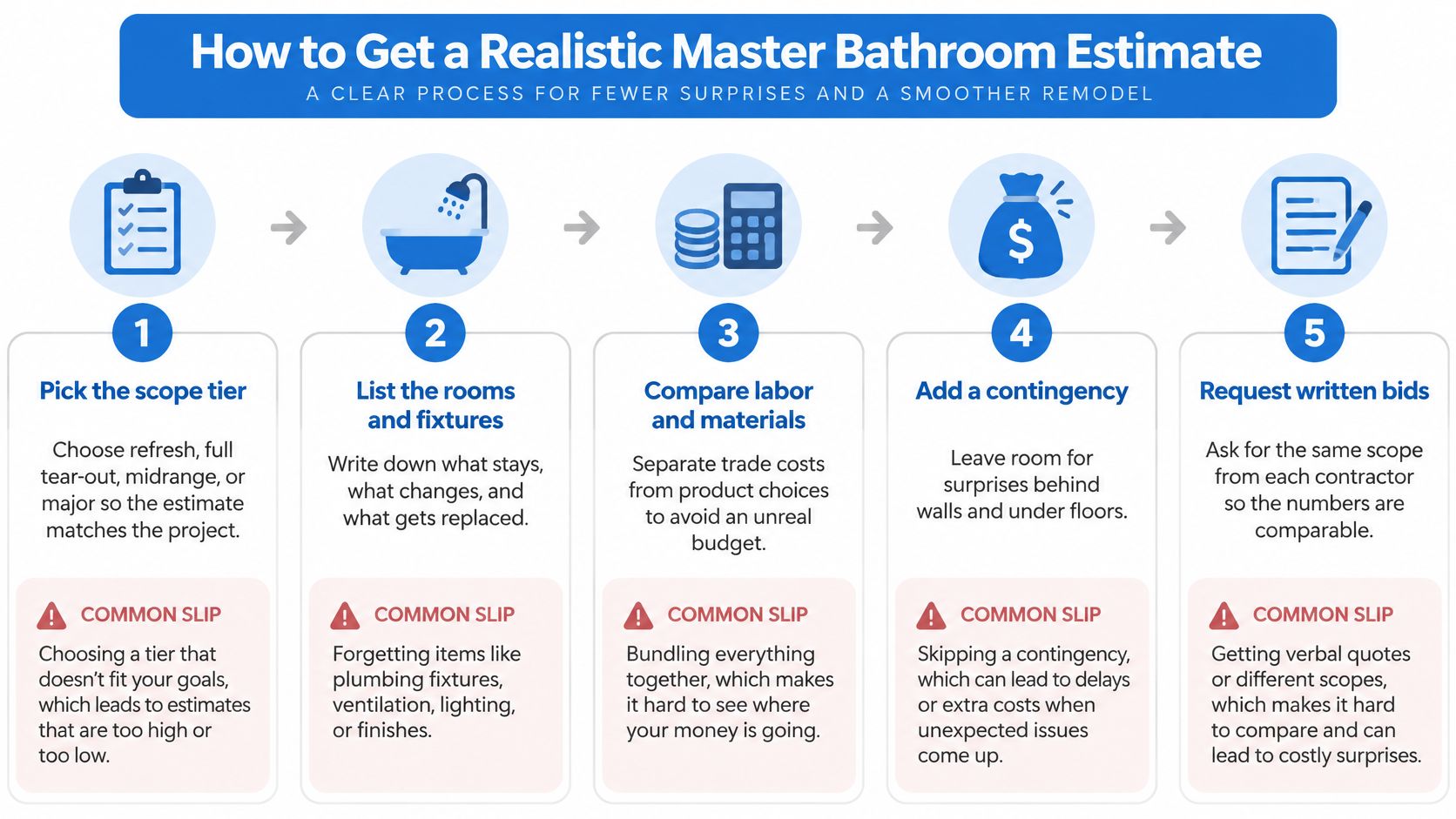
Pick the scope tier. Identify whether you want a refresh, replacement, midrange renovation, or custom major project. Comparing a complete rebuild with a cosmetic-update figure creates a false budget before anyone visits.
Measure and list every fixture. Record room dimensions, the shower opening, vanity width, and what stays or moves. Don't leave a proposed toilet relocation as an informal comment during the walkthrough.
Request trade-level detail. Include demolition, rough plumbing, electrical, waterproofing, tile, cabinetry, fixtures, finish carpentry, permits, and the treatment of unforeseen work. A total without a defined scope gives you little basis for comparison.
Separate included products from allowances. Identify who supplies each item and what the allowance includes, such as delivery, accessories, and installation components. Treating a placeholder as the final product price is an easy way to underestimate the commitment.
Check that the labor scope is complete. Look for preparation, installation, protection, disposal, and coordination, not just product costs. A surprisingly inexpensive bid deserves an explanation of inclusions, not an automatic signature.
Confirm the wet-area assembly. The proposal should identify waterproofing and substrate preparation for the shower and relevant wet surfaces. A tile line alone doesn't tell you how the room will manage water.
Resolve permits and access needs. Identify applicable approvals and any accessibility modifications before signing. Leaving these unresolved makes both cost and scheduling harder to manage.
Know what the estimate includes
Our on-site consultation is performed by a qualified general contractor who helps plan the project. We offer a complimentary estimate for all labor and materials, and our Materials & Construction Estimate provides labor-and-material-inclusive deals using our wholesale material resources.
Use the bathroom remodel estimate guide to organize your comparison. A usable estimate matches the scope, names allowances, and writes down exclusions, including how additional work will be documented and approved.
Set Your Budget Tier and Book a Walkthrough
Choose the project you can describe clearly, not the price you hope will somehow cover everything. A bathroom budget becomes much easier to manage when the household agrees on the boundary between necessary work and optional upgrades.
Your decision can be straightforward:
- Keep the working room: Choose a refresh when paint, lighting, and visible fixture updates solve the problem.
- Replace worn components: Choose a full tear-out when the arrangement works but the shower, flooring, and vanity need replacement.
- Rebuild to a defined specification: Choose a midrange scope when you want a coordinated replacement with controlled product selections.
- Redesign around specific needs: Choose a custom estimate when you want a different layout, heated floors, extensive glass, or substantially more space.
Make the walkthrough answer practical questions
Before the visit, agree on what frustrates you most. Is it the shower threshold, the lack of drawers, the poor lighting, or the unused tub occupying valuable space? Rank those issues so an attractive upgrade doesn't displace the reason you started.
Bring your room measurements, photos, fixture list, and preferred finish examples. Also bring a clear spending limit and identify the money you intend to hold outside the construction commitment.
National benchmarks aren't Orange County or Los Angeles bids. Local labor, permits, disposal, property access, and the condition of the existing bathroom must be addressed in the estimate for your home.
We offer a free in-home consultation, bookable through the contact form or by calling 949-594-6444. We're licensed and insured in California under CSLB #1095347 and serve Orange County, Los Angeles County, the Inland Empire, and Riverside County.
Confirm coverage when booking and explain whether the bathroom is your household's only bathing space. That detail belongs in the planning conversation, not in a panicked discussion after demolition.
Write your chosen scope tier and reserve amount on the first page of the project file.
Epic Remodeling offers a free in-home consultation and a complimentary labor-and-materials estimate to help turn your bathroom wish list into a defined construction scope. Visit Epic Remodeling to request a walkthrough, and bring your measurements, must-have changes, and budget limit so we can plan the bathroom around what matters to you.