How to Finance a Home Remodel Without Overpaying
See how to finance a home remodel: compare cash, HELOCs, and loans, then match draws to a real contractor estimate.

76% of home-improvement projects were paid for mainly with cash, according to Harvard's Joint Center for Housing Studies. Borrowing isn't the automatic starting point. The key question is how much cash you can safely commit, then how to finance the gap without paying interest before you need the money.
If you're figuring out how to finance a home remodel, start with the contractor's payment schedule, not a lender's teaser rate. A cheap-looking loan can become expensive while permits sit pending and borrowed money sits untouched. The best fit matches your project's size, payment milestones, and contingency reserve, without turning every construction surprise into a credit-card balance.
Financing Options by Remodel Size
Project size changes the borrowing decision. Historical findings from Harvard's Joint Center for Housing Studies put financed spending at approximately 34.2% of all home-improvement expenditures, with borrowing covering less than 17% of expenditures for homeowners spending under $5,000, compared with almost 42% for households undertaking larger improvements.
That's a useful distinction, not a prescription to borrow. A repair you can cover comfortably from savings doesn't need a mortgage application attached to it. A substantial renovation deserves a structured comparison before you pledge the house or accept a large unsecured payment.
Remodel financing options compared
| Option | Best project fit | Collateral | Rate style | Interest starts on |
|---|---|---|---|---|
| Cash and savings | Repairs and any scope you can fund without draining reserves | None | None | Nothing borrowed |
| HELOC | Phased kitchens, baths, and mid-size remodels with uncertain final scope | Your home | Usually variable | Amounts actually drawn |
| Home-equity loan | Defined scope with a fixed contract price | Your home | Fixed | Full lump sum at funding |
| Cash-out refinance | Large remodel when replacing the first mortgage also makes sense | Your home | Typically fixed | Full new mortgage balance, including cash-out |
| Personal loan | Smaller unsecured gap when equity is thin or you won't pledge the house | None | Usually fixed | Full amount at funding |
| Credit card | Short-gap materials or a small finish purchase you can repay promptly | None | Variable, often high | Unpaid balance under the account's terms |
| Renovation mortgage such as HomeStyle | Major remodel tied to a purchase or mortgage financing documented renovation costs | Your home | Mortgage rate | Mortgage balance under the loan terms; contractor payments follow escrow draws |
A draw-based renovation mortgage isn't the same as a HELOC. Controlled releases to the contractor don't automatically mean you pay interest only as construction draws occur. Have the lender explain the mortgage's interest treatment separately from its escrow-release rules.
Two budgets, different priorities
Say you're planning a modest guest-bath refresh. You've got some dedicated savings, a stable income, and a remaining gap you can repay comfortably over a short term. Cash plus a personal loan belongs on your shortlist because you aren't adding a property lien for a relatively contained project.
That doesn't make the personal loan cheap by definition. Compare its APR, fees, required payment, and total repayment against the alternatives. Keeping the house out of the collateral agreement is valuable, but it doesn't excuse an unaffordable payment.
Now consider a full kitchen reconfiguration or room addition, with structural work, coordinated trades, and staged invoices. Equity financing deserves a closer look because the borrowing need is larger and the payment sequence is longer. Use a room addition cost calculator to organize an initial budget, then replace planning assumptions with an itemized contractor bid.
Cash-out refinancing needs a separate test: would you still accept the new mortgage terms if the remodel weren't happening? Don't reprice your entire existing mortgage merely because the cash-out portion looks convenient.
Selection rule: Choose the funding structure that fits the project, then compare offers within that structure. Don't let an attractive rate talk you into the wrong kind of debt.
Steps to Finance a Remodel in the Right Order
Get preliminary lending guidance early, but don't commit to borrowing against an undefined project. You can ask about qualification, documentation, and product availability while planning. The amount you finance should come from a written scope, not a hopeful round number.
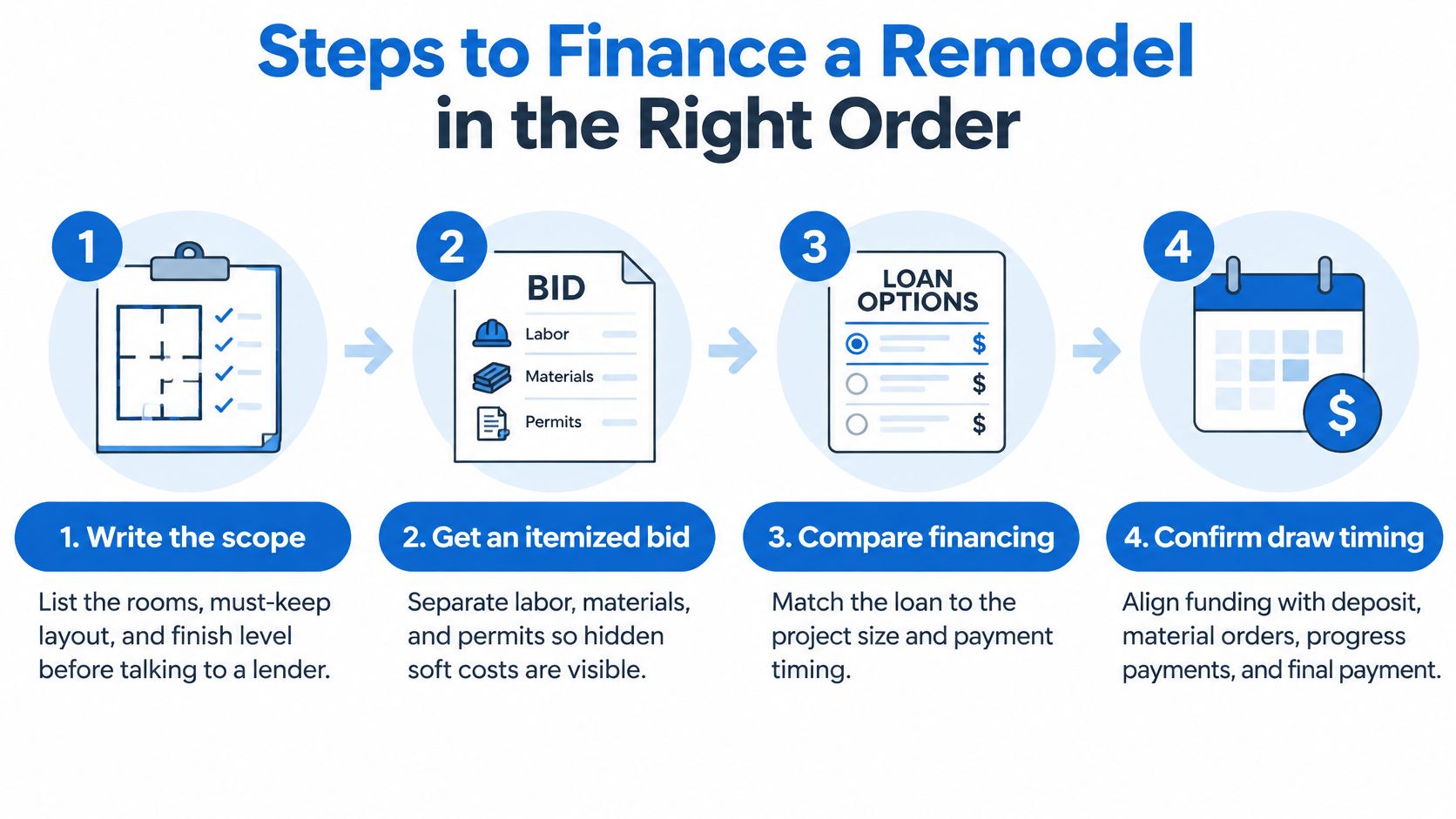
Keep the planning sequence visible while you build the budget.
Define what you're buying
Write the scope before shopping for money. Name the rooms, the layout you're keeping, the fixtures you're moving, and the finish level you expect. Separate necessities from optional upgrades so you can reduce the scope intelligently if the financing doesn't fit.
For a kitchen, “new cabinets and counters” leaves too much unanswered. Specify whether you're moving the sink, changing appliance locations, removing a wall, or replacing the electrical panel. Those decisions affect more than the cabinet order.
Get an itemized bid. Ask for labor, materials, permits, engineering, utility upgrades, and allowances to be identifiable. An allowance should name what it covers and what happens when your selection exceeds it.
Additions and ADUs deserve particular attention to site work, utility connections, and code-related work. Don't accept a tidy construction total that excludes those categories from the estimate.
Build a complete project budget. Use separate spreadsheet lines for construction, design and permitting, financing costs, temporary living arrangements, and owner-supplied purchases. Include delivery, storage, and installation responsibilities for anything you buy yourself.
If the base scope already feels uncomfortable, revise it before applying. These kitchen remodeling budget decisions can help you distinguish functional improvements from expensive layout changes. Cutting optional work before signing is much cleaner than trying to extract it from an active contract.
Protect the money that isn't for upgrades
Create a dedicated contingency. Fannie Mae's HomeStyle renovation guidance identifies a 10% contingency reserve for renovation mortgages secured by two- to four-unit properties, with lenders able to increase it to 15% when scope and scale justify it. That's a program-specific requirement, not a universal percentage for every home remodel.
Build the applicable reserve against the complete renovation cost base, including labor, materials, permits, plans, inspections, and related fees. Reserve money is for necessary unforeseen repairs or deficiencies, not the backsplash you discover after the tile order is placed.
Keep household emergency savings separate. Houzz reported that 84% of homeowners used savings for their 2024 renovations. Using savings is common; using every available dollar is a different decision.
Decide what must remain untouched for household emergencies. Then calculate how much cash is available for construction. A new shower won't cover a lost paycheck.
Unused lender-provided contingency generally reduces the outstanding loan balance after completion under the cited HomeStyle rules; borrower-provided funds may receive different treatment. Mortgage payments belong in renovation escrow only when the lender has explicitly arranged that coverage.
Test affordability before committing
Finance the approved base scope, with the required reserve clearly identified. Don't borrow for a collection of possible upgrades you haven't priced. Keep optional work on a separate list and authorize it only when its funding is settled.
Run a delayed-completion budget. Put the proposed loan payment beside your current mortgage, existing debts, insurance, utilities, and ordinary household spending. Add temporary housing or other disruption-related expenses where relevant.
Then extend the construction timeline in your spreadsheet. Ask whether you could still carry the payments if you had to keep paying for an unfinished kitchen and alternative living arrangements at the same time. Lender approval tells you what the lender will accept, not what your household will enjoy living with.
Apply with the scope, permit assumptions, reserve, and payment calendar documented. Request comparable written offers for the same borrowing need. Compare APR, fees, repayment term, payment changes, and total repayment, rather than ranking offers by the introductory payment.
Before comparing APRs, write contingency reserve as its own budget line. If you can't identify where that money will come from, the project isn't fully funded yet.
What Lenders Check Before They Fund the Work
Your borrowing capacity can hit a property-value limit before it hits your desired budget. Fannie Mae's HomeStyle Renovation program generally limits eligible renovation costs to 75% of the lesser of the purchase price plus renovation costs or the property's as-completed appraised value, and a lender may fund up to 50% of planned renovation costs at closing.
That renovation-cost limit isn't a promise of a particular mortgage amount. The lender still determines the mortgage and loan-to-value eligibility. Ask which calculation limits your transaction before you commit to a construction scope.
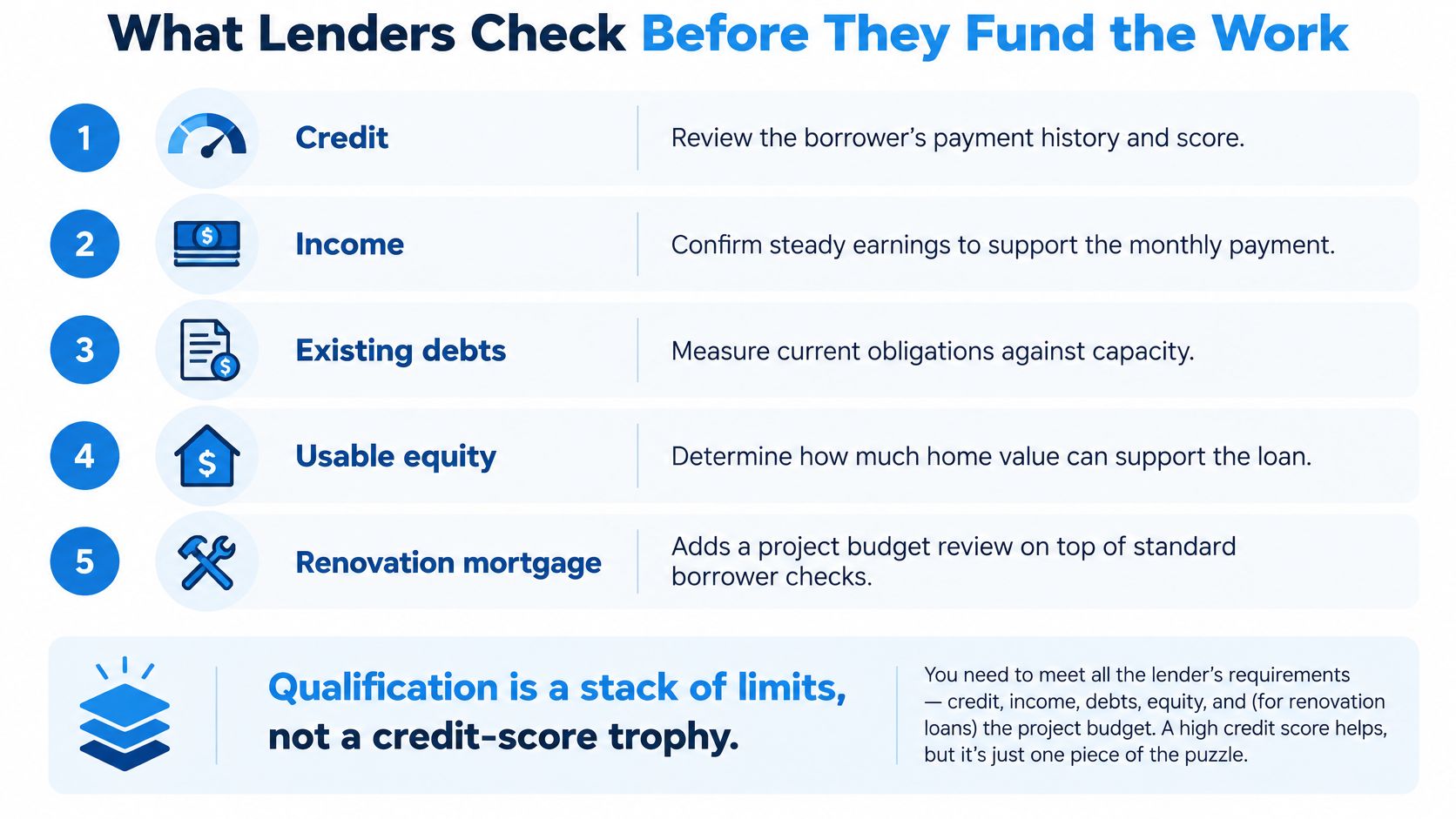
Qualification is a stack of limits
A strong credit score doesn't cancel out insufficient income, heavy existing debts, or limited usable equity. Each product has a different bottleneck, and you need to identify yours before paying for plans you can't finance.
A renovation mortgage adds another layer: the lender reviews the project itself. Expect to provide your selected contractor's itemized bid, plans, specifications, permit assumptions, and construction schedule, followed by an appraisal based on the completed condition.
What usually gates each remodel loan
| Product | Binding constraint | Documents that matter | If you miss it |
|---|---|---|---|
| HELOC | Available equity and credit-line limit | Income records, credit, and appraisal or automated valuation | The line falls short of planned draws |
| Home-equity loan | Combined loan-to-value and fixed loan amount | Appraisal, income records, and debt-to-income calculation | The approved lump sum doesn't cover the scope |
| Cash-out refinance | New first-mortgage underwriting and closing costs | Full mortgage application and appraisal | The new overall payment undermines affordability |
| Personal loan | Credit, income, and unsecured debt load | Pay stubs and existing obligations | Rate or repayment term creates an excessive payment |
| Credit card | Credit limit and utilization | Account terms and available credit | Progress payments become high-APR revolving debt |
| HomeStyle-style renovation mortgage | Renovation-cost eligibility, completed value, and mortgage underwriting | Contractor bid, plans, schedule, and as-completed appraisal | Extra cash, redesign, or a smaller project |
Approval isn't immediate access
For a renovation mortgage, funds sit in escrow and the lender releases them through its approved process. Completed work must match the approved plans and bids, and draw requests require verification. Your contractor's invoice alone may not trigger payment.
Ask who submits each draw, who verifies the work, what documentation is required, and how payment reaches the contractor. Also identify who pays permit fees, deposits, and early material orders before a construction draw becomes available.
The appraisal deserves attention before the final contract, not after it. Spending more on construction doesn't guarantee a matching increase in appraised value. If the completed valuation can't support the proposed financing, you'll need more cash, a revised design, or less work.
Get lender approval before signing material change orders. An attractive change can still fall outside the approved financing scope, leaving the contractor ready to proceed and the lender unwilling to release money.
Match the Loan to Contractor Draw Timing
The lowest advertised rate is the wrong scoreboard if you ignore when interest starts. A loan that funds everything upfront and a line you draw gradually aren't interchangeable, even when their quoted rates look close.
Financing choices are scattered: survey reporting in the Missoulian found 13% of homeowners chose a HELOC, while 10% chose a home-equity loan. Neither choice wins automatically. The better question is which arrangement fits the invoices you'll receive.
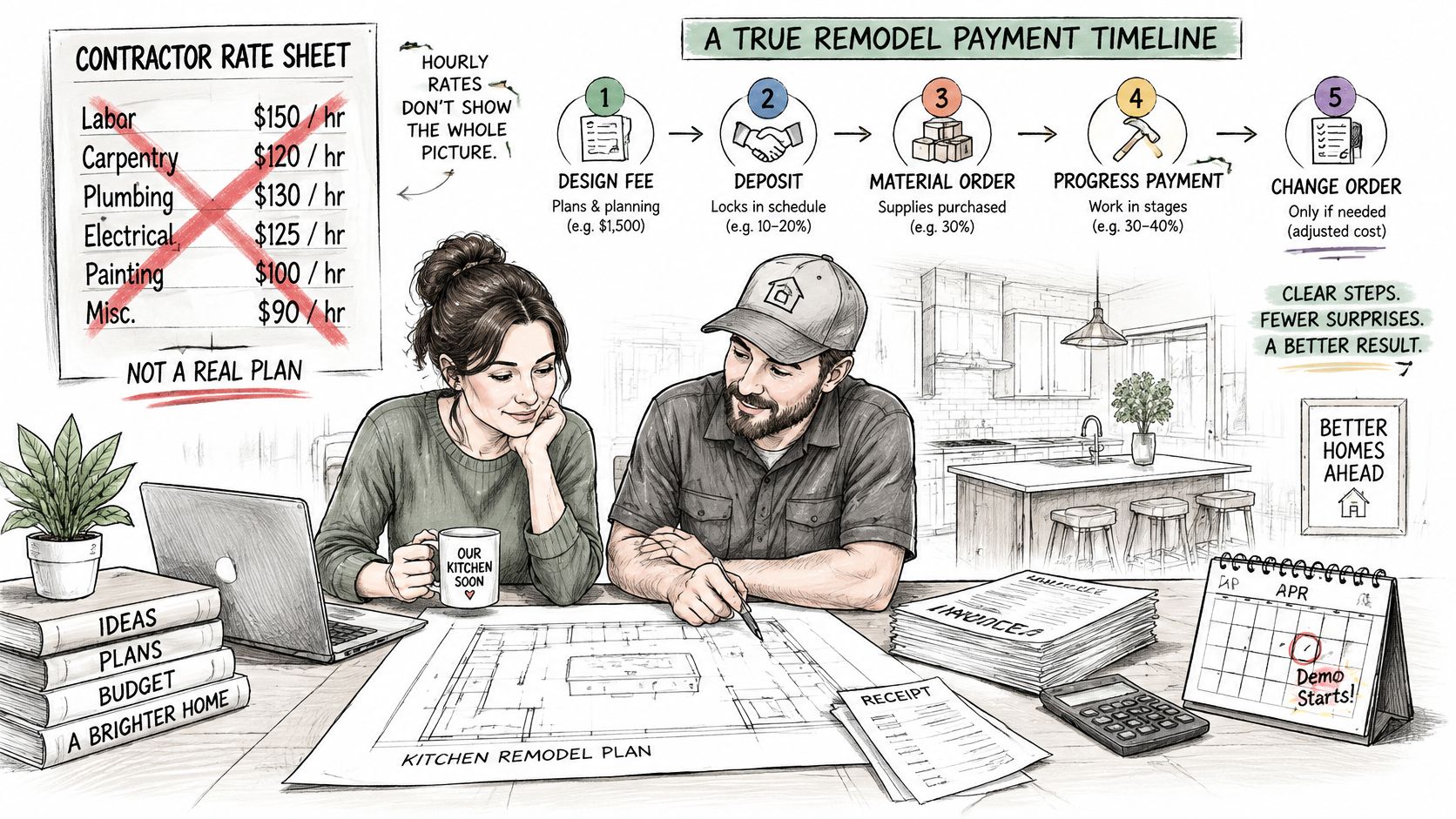
Put payments on a calendar
For a hypothetical phased kitchen remodel, sketch the payment sequence below. The week labels are illustrative, not a recommended deposit deadline or a promised construction schedule. Use your actual contract milestones before choosing funding.
Phased kitchen payment calendar
| Stage | Payment | Funding source | HELOC interest | Lump-sum interest |
|---|---|---|---|---|
| Week 0 | Design and permit fees | Savings | Nothing drawn | Full loan accruing if already funded |
| Week 2 | Deposit to contractor | Savings or first HELOC draw | Interest on drawn balance only | Full loan accruing |
| Rough-in | Progress payment | HELOC draw | Interest on outstanding draws | Full loan accruing |
| Drywall | Progress payment | HELOC draw | Interest on outstanding draws | Full loan accruing |
| Finish | Final payment and approved change orders | HELOC draw or applicable contingency reserve | Interest on outstanding draws | Full loan accruing |
A HELOC generally suits staged spending because you can draw as bills become payable. Its trade-off is a usually variable rate and a lien on your home. Flexible access isn't the same as a predictable payment.
A fixed-rate home-equity loan offers payment certainty. It can work well when the price is settled and funds will be deployed promptly, but an early funding date creates interest expense on money you haven't used.
Make both options survive the same delay
Ask the HELOC lender to show the payment at a higher rate, including what happens when the draw period ends. For a lump-sum offer, ask what financing costs you'll incur if construction starts later than planned. Compare the same delay, not an optimistic schedule for your favorite product and a disaster scenario for the other.
Give every planned invoice a funding source. Don't label predictable progress payments “credit card for now” unless you already have a reliable payoff source and understand the account terms. That's not contingency planning; it's an unfinished financing plan.
Timing test: Draw-based access fits a moving payment calendar. A fixed lump sum fits a settled scope and prompt spending. Neither is a bargain if its required payment strains your household.
For a cash-out refinance, evaluate the entire replacement mortgage rather than just the renovation proceeds. For a renovation mortgage, confirm that the contractor can work within the lender's draw procedures before anyone orders materials.
Lock the Estimate Before You Borrow
Lock the base scope, not a fantasy that nothing will change. A good estimate makes known work explicit, flags assumptions, and gives you a controlled way to approve discoveries. It doesn't pretend every condition behind a wall is visible.
Review the exclusions as closely as the total. If a contractor's bid looks dramatically leaner, determine whether it includes the same demolition, preparation, utility work, finishes, and cleanup. You're comparing commitments, not typography.
Give each funding path a clear next action
- Cash and savings: Confirm the written scope and keep the construction reserve accessible. Don't tie up money needed for near-term invoices in an account you can't readily access.
- HELOC: Confirm the draw period accommodates the project calendar. Understand minimum payments, possible rate changes, fees, and the repayment structure after drawing ends.
- Home-equity or personal loan: Coordinate funding with a settled contract and realistic start. Avoid borrowing early merely because the application is finished.
- Cash-out refinance: Approve the replacement mortgage on its overall merits. Include closing costs and the effect on your existing balance, not just the cash available for construction.
- Renovation mortgage: Resolve the completed-value review and required project approvals before signing an unconditional construction commitment. Make sure the contractor understands the lender's release process.
Ask the lender a blunt question: Which number is limiting this loan? It might be your payment capacity, available equity, the property valuation, or the program's eligible project costs. Knowing the bottleneck tells you whether to change the financing, contribute cash, or reduce the work.
Judge the estimate before accepting the debt
Your estimate should identify code upgrades, utility work, engineering, inspections, material allowances, and owner responsibilities. It should also explain how substitutions and change orders get priced and approved. For a bathroom project, use a bathroom remodel estimate checklist to organize those questions before comparing totals.
At Epic Remodeling, we design projects to the client's budget and walk clients through planning, design, and construction. Bring your borrowing ceiling into that planning conversation so the scope is developed around money you can commit.
Take the documented project amount to the lender, not an aspirational estimate plus a vague promise to find the rest later. Choose the loan after the work and payment obligations are clear. The countertop gets plenty of attention; the funding calendar deserves some too.
We offer flexible financing and a free in-home consultation to help you connect your remodeling plans with a workable budget. Visit Epic Remodeling to fill out the contact form, or call 949-594-6444 to book your consultation. Bring your scope, available cash, and financing questions so we can discuss the project before you commit to borrowing.