What Is a Tenant Improvement Allowance? How It Works
What is a tenant improvement allowance? Get the plain definition, the calculation, what it covers and how to negotiate a bigger one before signing.
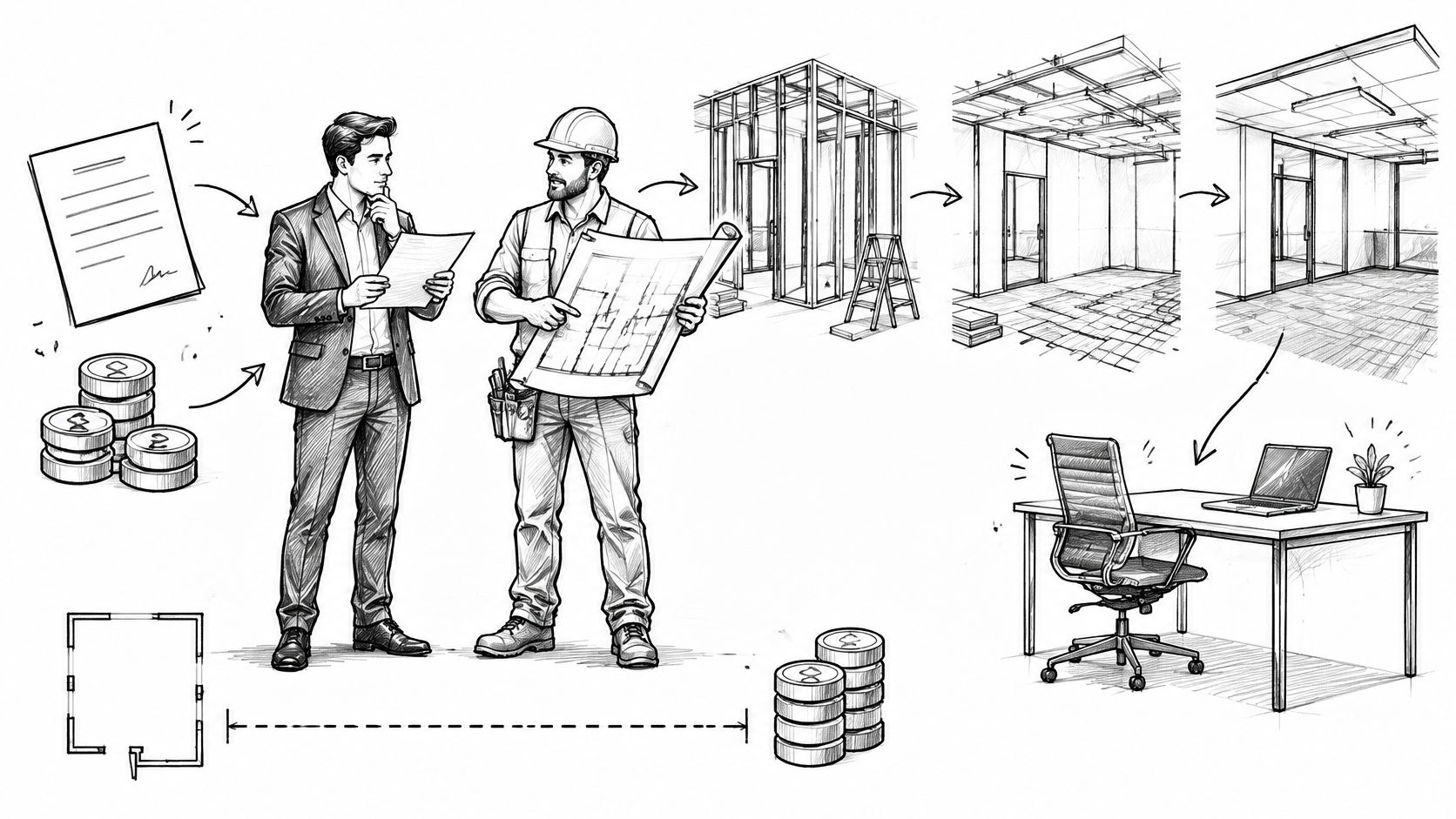
A tenant improvement allowance is a landlord's contribution toward the cost of customizing leased space for a tenant, usually stated as a dollar amount per rentable square foot or as a fixed maximum budget. You're probably staring at that line in a lease proposal right now, next to an empty shell that needs walls, lights, and plumbing before anyone can work there. The number looks generous. It rarely covers everything, and the fine print decides how much of it you'll use.
What a Tenant Improvement Allowance Actually Is
The landlord helps pay for the building's permanent bones, such as walls, ceilings, lighting and wiring. You bring the furniture, laptops and coffee machine, and you take those with you when you leave.
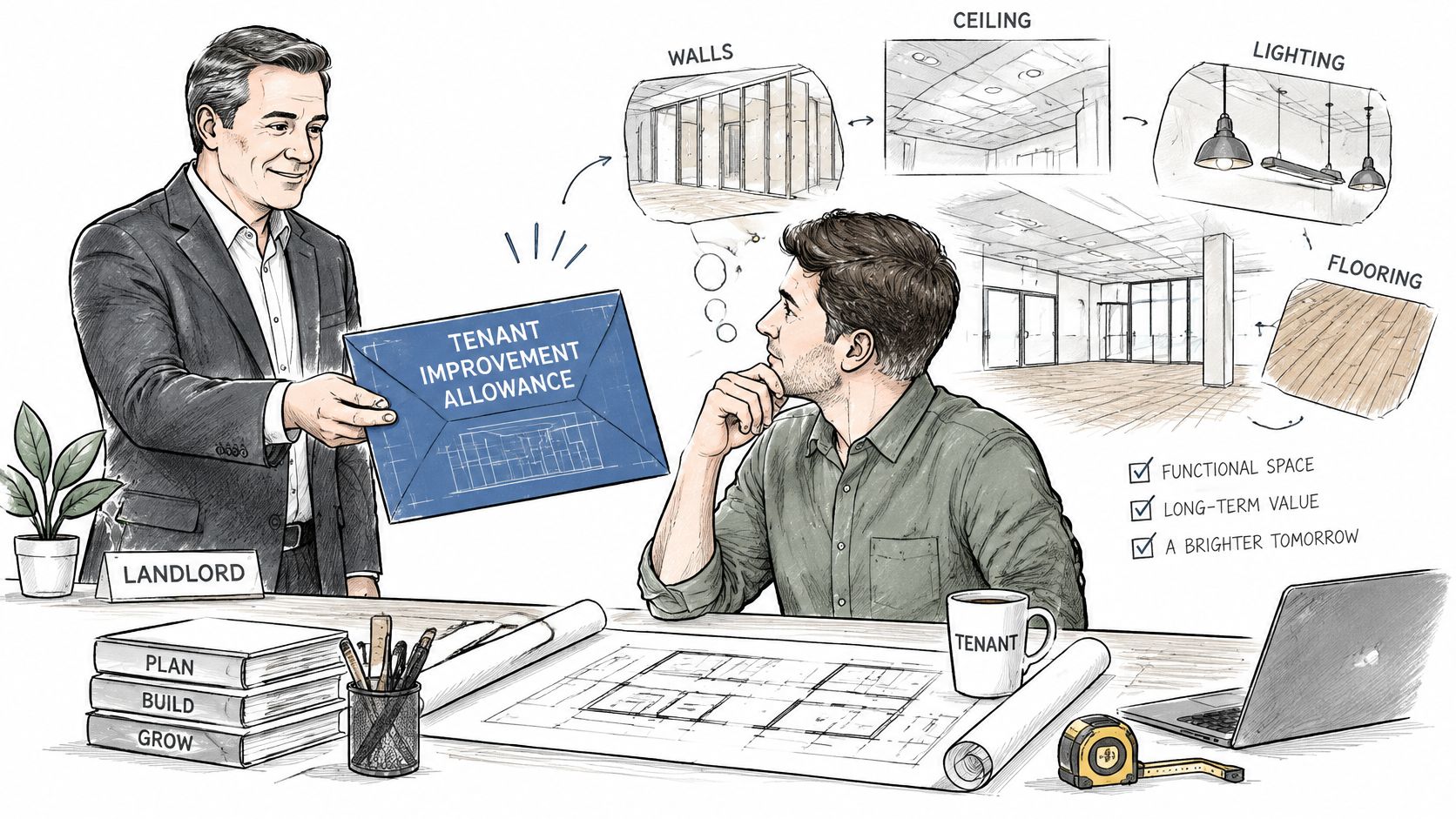
That stays or leaves test is the core definition. Permanent improvements stay attached to the building after your lease ends. Partitions, flooring, lighting, electrical distribution and built-in kitchens usually fit that description. Movable furniture and equipment usually don't.
Not Free Cash
Understanding what is a tenant improvement allowance starts with what it isn't. It's not a check you can spend anywhere. It's a contractual contribution, negotiated as part of the whole lease deal alongside rent, free-rent periods, term length, construction deadlines and who pays for overruns.
A bare shell rarely suits an office, restaurant or clinic, so the allowance exists to bridge the gap between empty space and usable space. The landlord benefits too, because those permanent improvements stay in the building.
The federal government runs a tidy version of the same idea. Under the federal leasing regulation on tenant improvement allowances, the allowance supports an agency's design, configuration and build-out, is based on local construction costs and historical space needs, and cannot exceed the stated figure. The agency pays only for the amount used, and that amount is amortized over a period in the occupancy agreement, not exceeding the useful life of the improvements.
A tenant improvement allowance is the landlord's capped contribution toward permanent build-out work, negotiated as part of your lease economics.
Say you're offered $50 per rentable square foot on 10,000 rentable square feet. That's a $500,000 maximum improvement budget. It is a ceiling, not a promise that your project costs $500,000. Design fees, permits, furniture or construction above the cap can still land on you.
That's the one-sentence version you can repeat to a broker. The landlord contributes up to a set amount toward approved permanent improvements, and you fund the rest.
How Landlords Calculate the Allowance Amount
You're touring a bare 10,000-rentable-square-foot floor and the leasing rep says the building offers $50 a foot. Quick mental math says half a million dollars. Before you spend any of it in your head, you need to know which two numbers the rep just multiplied, because landlords quote the allowance in two formats and only one of them works that way.
The first format is a rate per rentable square foot, like the $50 in that hallway conversation. The second is a fixed lump sum, a single maximum budget for the whole project. Both produce a cap. The rate just makes you do the multiplication yourself.
The rate version carries a built-in multiplier effect. Rentable square feet include your usable space plus a share of shared corridors, lobbies and restrooms, so a rate applied to rentable space produces a higher cap than the same rate applied only to the rooms you'll occupy. Confirm which square footage figure the lease uses before doing any math.
The Three Step Math
- Find the cap. Multiply the rate by rentable square feet, or use the stated lump sum.
- Price the project. Get a detailed construction estimate that covers design, permits and contingency alongside walls and flooring.
- Subtract. The gap between the estimate and the cap is your cash contribution. If the estimate is lower, the lease decides what happens to the difference.
That third step is where optimism goes to die, usually in a spreadsheet.
Run it in reverse, too. Say your estimate lands at $62 per square foot on those same 10,000 rentable square feet: the project costs $620,000, the $50 rate caps the landlord at $500,000, and you write a cheque for the other $120,000. When the estimate comes in under the cap, some leases let you apply the leftover to rent and others let it evaporate, so that clause is worth reading before you celebrate.
Landlords set the rate as one dial among several. A higher per-square-foot figure often arrives with fewer free-rent months attached, which means the offer that looks richest on the allowance line can cost more across the full term than a leaner one. Published market surveys confirm the spread: allowance rates and free-rent periods shift year to year and differ sharply by building class, with top-tier buildings typically offering richer per-square-foot figures than lower-tier properties. Treat any such average as scenery. Your signed lease is the only number that pays for drywall.
Sample allowance budgets at 10,000 and 20,000 rentable square feet (rates chosen to show how the cap moves)
| Scenario | Rentable sq ft | Allowance per sq ft | Maximum allowance |
|---|---|---|---|
| Smaller suite, mid-range rate | 10,000 | $50 | $500,000 |
| Larger suite, same rate | 20,000 | $50 | $1,000,000 |
| Same suite, softer rate | 20,000 | $30 | $600,000 |
| Same suite, richer rate | 20,000 | $90 | $1,800,000 |
| Half the space, double the rate | 10,000 | $100 | $1,000,000 |
Notice the last row: a smaller suite at a richer rate can match a bigger suite's cap exactly. The per-foot figure quoted on a tour means little until you know the square footage it multiplies and what your estimate says.
Office-market averages describe larger, longer transactions in major markets and move around by building class. They do not transfer mechanically to a small retail shop, restaurant, medical suite or local office. Building class, lease size, tenant credit, lease duration, existing infrastructure and scope all move the rate a landlord will put on paper.
A medical build-out with extra plumbing, or a restaurant needing kitchen exhaust and fire-life-safety work, can consume an office-sized allowance well before finishes begin. Compare the cap against a real estimate for your actual use, in your actual space, every time.
What the Allowance Covers and What Myths Leave Tenants Short
A tenant improvement allowance behaves like a store credit: generous inside one shop, worthless at the moving truck. The working test is simple. If a cost stays in the building when you leave, it is usually eligible. If it leaves with you, it usually is not. Your desks, computers and espresso machine fail that test before the conversation starts.
The lease and its work letter turn that rule into specifics. They define eligible improvements, approval procedures, documentation, payment timing and what happens to unused funds. Eligible scope may include partitions, ceilings, flooring, lighting, electrical distribution, plumbing, HVAC modifications, life-safety systems, millwork and accessibility upgrades.
Budget in parts rather than one hopeful lump. Split hard construction costs from design and engineering fees, permits, testing, project management and contingency. Soft costs eat a real share of any build-out, and the work letter decides whether the allowance carries them or you do. A tenant who learns that after signing funds those items personally.
Typical treatment of common build-out costs
| Cost item | Typical treatment | Who usually pays |
|---|---|---|
| Partitions, ceilings and flooring | Usually covered | Allowance, if the work letter lists them |
| Lighting and electrical distribution | Usually covered | Allowance |
| Plumbing, HVAC changes and life-safety systems | Often covered | Allowance, but check base-building responsibility |
| Kitchens and built-in millwork | Often covered | Allowance |
| Furniture, movable equipment and technology | Usually excluded | Tenant |
| Moving costs and removable trade fixtures | Usually excluded | Tenant |
| Design, engineering, permits and testing | Covered only if listed | Confirm in the work letter |
| Utility upgrades, abatement and after-hours work | Covered only if negotiated | Negotiate before signing |
Five Myths That Cost Tenants Money
- It's free cash. The allowance is a restricted contribution for approved work, released under lease conditions. Spend it on an unapproved item and that item becomes your expense.
- It covers the whole project. The federal definition of a tenant improvement allowance includes design, labor, materials, contractor, management and inspection costs, while excluding personal property and furniture. Anything outside that list needs its own line in the work letter.
- Every landlord offers the same package. Allowances differ in structure as much as in size: one landlord prices a dollar amount per square foot, another delivers a finished build-out, and a third trades improvement dollars for rent relief.
- Unused money is yours. The lease decides whether a balance is forfeited, applied to rent or retained by the landlord.
- The largest allowance is the best deal. A bigger figure can arrive attached to higher rent or fewer free-rent months, and the smaller package sometimes costs less over the full term.
A second squeeze catches tenants who only read the headline number. Class A improvement packages have grown in recent years, while fit-out costs have climbed alongside them, so a larger allowance than last year's can still purchase less construction.
The better question: What is the all-in cost of making the premises operational, and which line items qualify?
Ask for a line-item eligibility schedule before you sign. Confirm soft costs and permitting, name who bears overruns, and get utility upgrades, fire-alarm changes, hazardous-material abatement, after-hours work and landlord review fees answered in writing. Surprises are cheaper on paper than on a construction site.
How the Money Flows From Lease to Build-Out
The money rarely arrives as a lump sum on day one. It moves through approvals and paperwork, in an order your work letter should spell out.
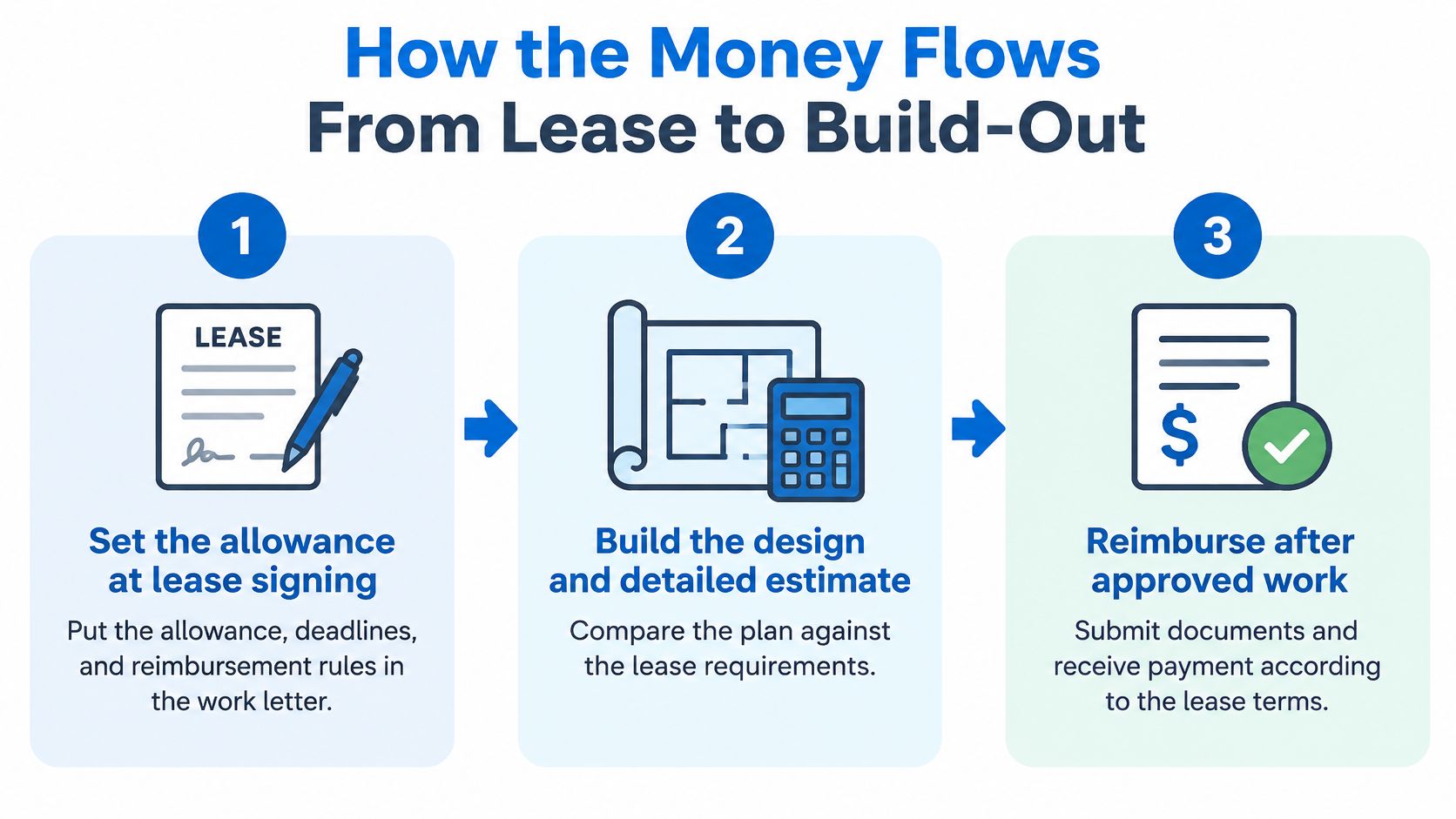
Six Steps From Signing to Reimbursement
- Set the rules at lease signing. Put the allowance amount, deadlines, eligible costs and reimbursement mechanics in the work letter.
- Design and estimate. Build the plans and a detailed estimate, then check both against the allowance before anyone orders materials.
- Get landlord approval. Submit plans and your contractor choice for approval, and wait for written sign-off.
- Build with written change orders. Approve every change in writing before the work starts, not after the invoice arrives. A restaurant project makes this real fast, because hood, grease and plumbing decisions in a commercial kitchen renovation ripple through mechanical and life-safety budgets.
- Submit the paper trail. Provide paid invoices, lien waivers, change-order records and closeout documents your lease requires.
- Receive reimbursement and settle up. Payment usually follows milestones, and any unused balance is handled under the lease terms.
Step 5 deserves respect. Landlords reimburse documented costs, not remembered costs. Sloppy paperwork can delay money you've already spent.
The Accounting Turn
Who owns the improvements, who pays the invoices and what the lease says all shape tax and accounting treatment. IRS technical guidance on tenant improvement allowances describes them as reimbursements for leasehold-improvement costs that may become improvements owned by the landlord, and states permanent improvements on leased property are recovered through depreciation or amortization rather than treated as ordinary rent expense. Improvements generally must be capitalized when they better, restore or adapt property to a new or different use, with recovery beginning when the improved property is placed in service.
Keep a separate ledger for allowance-funded work, tenant-funded overruns, design fees, permits and removable trade fixtures. Don't assume every invoice gets the same treatment.
Your lease should also allocate ownership and removal duties for specialty plumbing, equipment connections, security systems, cabinetry and medical or restaurant infrastructure. Those clauses affect your restoration liability when the lease ends, which is a bill nobody budgets for at the ribbon cutting.
Have your accountant and attorney review the allowance structure against rent abatement, reimbursement mechanics and tax rules before signing. That review is much cheaper before construction starts.
Run the Numbers on Allowance Versus Free Rent
Most guides stop at the allowance figure. The useful question is different. Which offer costs you less over the whole lease?
Say you're comparing two offers for the same 10,000 rentable-square-foot office. The term is five years at $40 per square foot a year, which is $400,000 a year and $2,000,000 in base rent. Your all-in build-out estimate is $900,000, or $90 per square foot.
These are illustrative figures for the arithmetic, not market quotes. Swap in your own rent, term and estimate and rerun them.
Offer A Versus Offer B
Offer A gives you $60 per square foot, or $600,000, with no free rent. You fund $300,000 of construction yourself and pay $2,000,000 in rent. Your total is $2,300,000.
Offer B gives you $50 per square foot, or $500,000, plus six months of free rent worth $200,000. You fund $400,000 of construction and pay $1,800,000 in rent. Your total is $2,200,000.
Illustrative five-year offers at 10,000 rentable sq ft and a $900,000 all-in build-out
| Offer | Allowance per sq ft | Allowance total | Free rent |
|---|---|---|---|
| Offer A, higher allowance, no free rent | $60 | $600,000 | 0 months |
| Offer B, lower allowance with free rent | $50 | $500,000 | 6 months |
Total tenant cost equals your out-of-pocket construction share plus base rent paid after free months. By that measure, the extra $100,000 of allowance in Offer A is worth less than the six free months in Offer B. The smaller allowance costs you $100,000 less.
A dollar of allowance and a dollar of free rent both reduce what you pay. Count both, or you'll pick the shinier number and overpay.
Change the build-out cost, rent or term and the winner can flip. If your build-out were cheaper, free rent would matter even more, because you'd need less construction money. If rent were lower, each free month would be worth less.
Cash timing matters too. Offer B asks you to fund more construction up front, even though it wins overall. If that strains your reserves, weigh it against other capital choices, the way you'd compare options for how to finance a home remodel before committing to a loan.
This example ignores discounting, operating costs and taxes. Your accountant should add those before you choose. The point stands either way. Compare total occupancy cost, not the headline allowance.
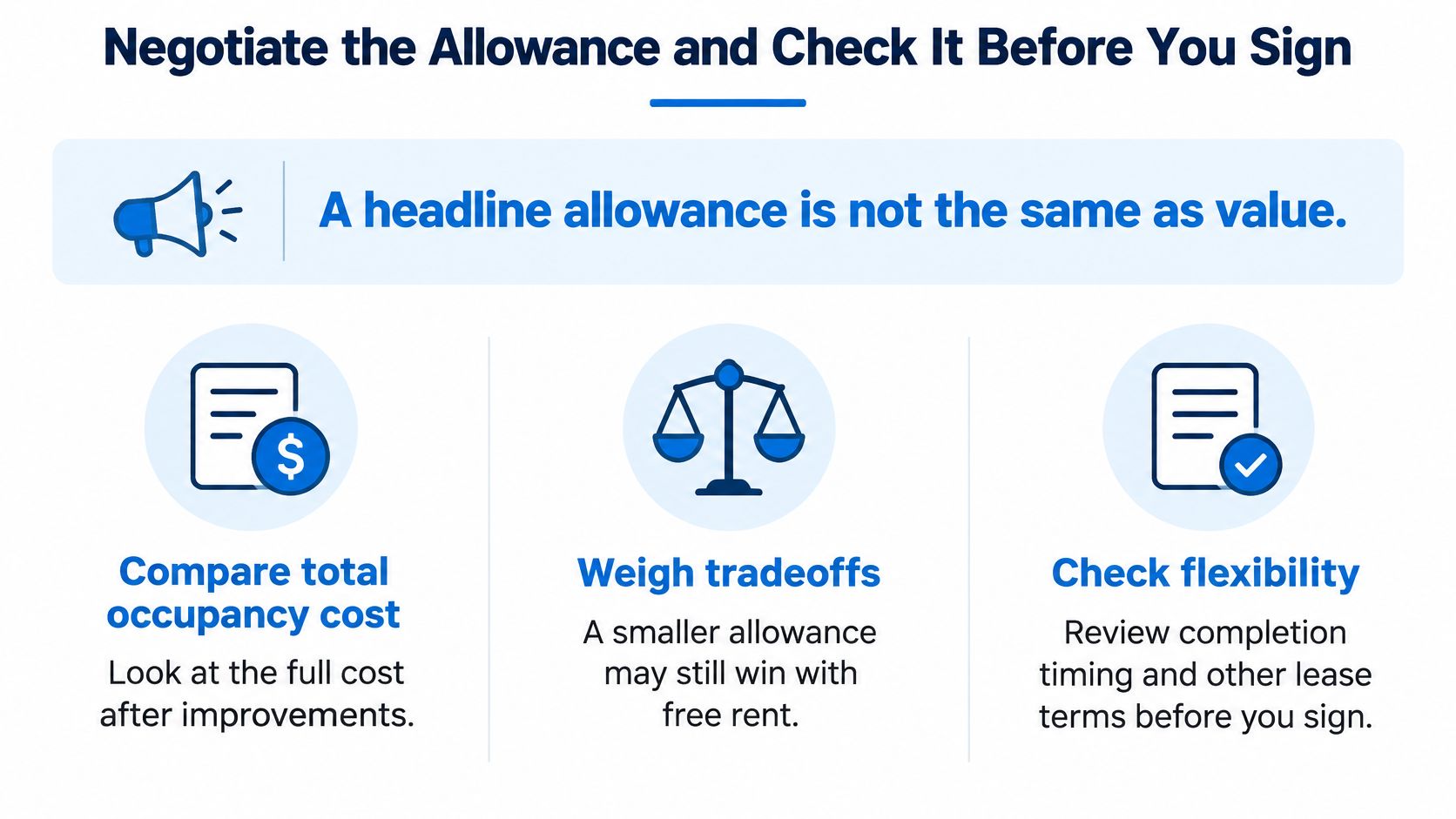
Negotiate the Allowance and Check It Before You Sign
A headline allowance is not the same as value. A smaller allowance paired with free rent, flexible completion dates or landlord-managed construction can beat a bigger allowance attached to higher rent.
Recent market tension shows why. Commercial Observer's reporting on New York office build-out costs put office TI allowances in leading U.S. markets at 68% above pre-pandemic levels, while New York corporate build-out costs reached approximately $212.59 per square foot in 2025. A large allowance and a large tenant-funded gap can absolutely coexist.
Allowances also track lease length, because greater landlord TI spending is associated with longer income commitments. If a landlord offers more money, expect a longer term in return. Decide whether that commitment suits your business before celebrating the number.
What to Negotiate Beyond the Dollar Figure
- Free-rent periods. They offset cash outlay while you build and ramp up.
- Rent commencement tied to delivery. Rent shouldn't start before the space is delivered as promised.
- Construction-period access. Your contractor needs entry before rent starts, in writing.
- Landlord approval deadlines. Slow approvals burn your schedule, not the landlord's.
- Reimbursement milestones and lien waivers. Agree when money moves and what paper triggers it.
- Change-order authority and late-delivery remedies. Name who can approve changes and what happens if delivery slips.
Specialty spaces need extra care here. Mechanical, plumbing, accessibility and life-safety requirements drive costs in restaurants, medical suites and retail, and details like restroom scope in a commercial bathroom remodel can trigger code work that eats allowance quickly.
Your Pre-Signing Checklist
- Request a line-item eligibility schedule covering soft costs, permits and furniture.
- Build an all-in budget from a detailed estimate and set the allowance beside it.
- Calculate total occupancy cost including rent, free months and full term.
- Confirm delivery date, rent trigger and late-delivery remedies.
- Confirm who pays overruns and what happens to unused funds.
- Have your accountant and attorney review ownership and removal terms.
A contractor's estimate is your advantage in this conversation, because it turns your ask into a documented number. We offer a complimentary estimate for all labor and materials, and our commercial work includes office build-outs, retail spaces, restaurants and medical facilities, with a dedicated project manager supervising from start to completion. Bring that kind of priced scope to the negotiation, not a guess.
Answer what is a tenant improvement allowance correctly and the lease gets easier to judge. It's one lever among rent, term and free months. Price the whole deal, in writing, before you sign it.
If you're weighing a lease in Southern California, bring us the work letter before you sign and we'll price the build-out against your allowance, line by line, so you know your real cash contribution. Visit Epic Remodeling to request your complimentary estimate and talk through your office, retail, restaurant or medical project with a dedicated project manager.