Cabinet Refacing vs Replacing: Costs and Which Wins
Cabinet refacing vs replacing compared on cost, timeline, design and kitchen condition, with a clear verdict for each situation.
The drawer front next to the cutlery divider doesn't close all the way. The oak doors wear that orange honey stain that was everywhere in the mid-nineties, and one has a hairline crack by the handle. Everything else about the kitchen is fine. The sink sits where a sink should, the range has counter on both sides, and there's a cupboard deep enough to lose a slow cooker in.
Then the quotes arrive. One is a five-figure number for new cabinetry. The other is a fraction of that to reface what's already hanging on the wall. It's tempting to read that as a price fight and take the cheaper ticket.
It isn't a price fight. It's a question of scope, and three things settle it: whether the cabinet boxes are sound, whether the layout works, and whether the option you choose will put you back in this same decision in a few years. Get those right and the money sorts itself out. Get them wrong and you'll pay twice.
Refacing and Replacing at a Glance
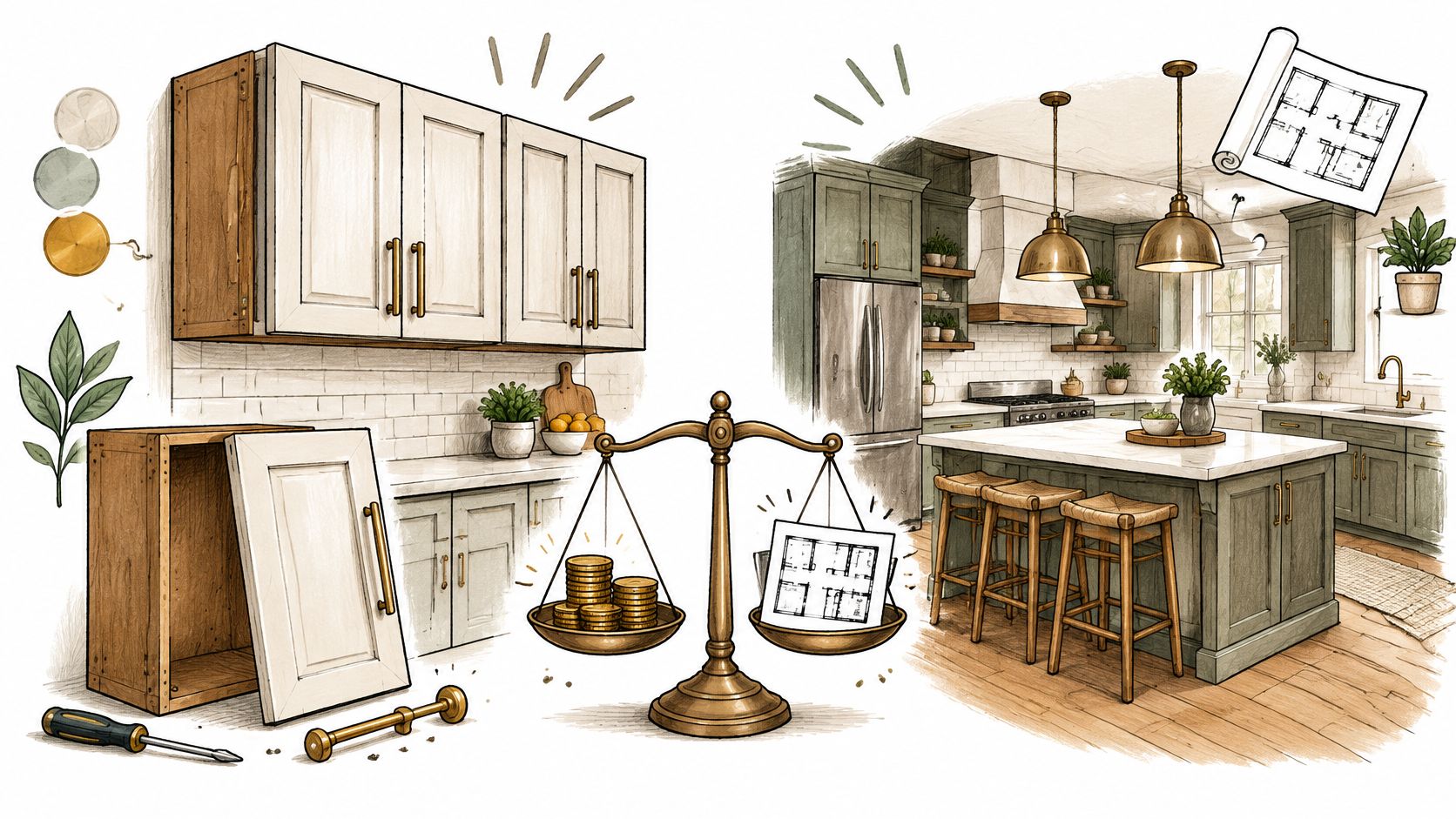
Refacing keeps the cabinet boxes and changes the faces: new doors, new drawer fronts, and fresh veneer or laminate over the exposed frames and end panels. Replacement takes the entire set out, down to the wall, and builds new from the carcass up. Every other difference below follows from those two sentences.
Here's the comparison before the details get interesting.
| Criterion | Refacing | Full replacement |
|---|---|---|
| Upfront cost | Lower; depends on doors and hardware | Higher; new boxes and installation |
| Project scope | Doors, drawer fronts and veneer; boxes stay | Boxes, doors, hardware and installation |
| Design flexibility | Fixed footprint and box sizes | Any layout, depth and storage plan |
| Timeline | Shorter on site | Longer, including manufacturing lead time |
| Disruption | Low; sink and counters often usable | High; kitchen often out of service |
| Waste | Low; mostly doors and hardware | High; the full box set is removed |
| Best fit | Sound boxes and a layout that works | Layout, storage or box damage problems |
Upfront cost is the row everyone reads first and the least informative one. Refacing is cheaper because you aren't buying boxes, which is also exactly why it can't fix a bad box. Scope is the honest column: faces on one side of the table, an entire cabinet system on the other.
Design flexibility is where the two part company. Refacing works inside the footprint you already own, at the door sizes and box depths the original builder picked. Replacement lets you go taller on the uppers, deeper on the base drawers, and add the pull-out that ends the Tupperware avalanche.
Timeline and disruption travel together. Refacing is a shorter, lighter job that usually leaves the sink and counters usable for most of it. Replacement takes the kitchen out of service, because the boxes come off the wall and something has to hold the countertop up.
The one-line rule: reface when the boxes are sound and the layout works. Replace when the layout or the boxes are the problem.
What Each Option Actually Includes
A refacing quote and a replacement quote can look nearly identical on paper: a lump sum, a start date, a finish color. They buy very different things, and the gap is where budgets go sideways.
The refacing scope, line by line
- Doors and drawer fronts: new, sized to the existing openings. Most of the money goes here, with door style and grade moving the price most.
- Veneer or laminate on the visible box: face frames, end panels, the exposed sides of any run, and the toe kick.
- Hardware, if specified: adjustable soft-close hinges and full-extension slides are frequently quoted as extras rather than included.
- Fillers and trim: the strips that make new doors line up with old openings and close the gaps between runs.
- Haul-away of the old doors: usually listed, occasionally discovered later.
What replacement adds to the bill
Replacement covers everything above plus the carcasses themselves, the labor to set them level and plumb, demolition of the old set, and disposal. That's the difference between a new face and a new cabinet.
Refacing is the faster, lower-waste intervention on paper, but its result depends heavily on substrate condition, adhesive preparation, and the door or face material, as a comparison of refacing's environmental impact sets out. It sends roughly 50 to 100 pounds of material to disposal against 400 to 800 pounds for a full replacement, project-specific figures rather than a universal benchmark. It also can't go over a box that's already swollen from a leak.
The hardware trap
Take a kitchen with twelve doors and four drawer fronts. The base proposal covers new doors, veneer and labor. Then the homeowner adds adjustable soft-close hinges, full-extension slides, four extra fillers and upgraded toe kicks. The total climbs toward mid-range replacement money, and the boxes are still the ones from 1994.
Practical rule: if a proposal doesn't list hinges, slides, fillers and toe kicks as separate lines, you're comparing one number to a different number.
Reading two proposals side by side
Lay both quotes on the table and check that each lists the same door count, the same hinge brand and slide rating, the same filler count, the same veneer or laminate grade, and the same warranty and edge treatment. Rigid thermofoil, laminate and wood veneer behave differently around moisture, heat, scratches and repairs, so "refacing" isn't a single performance category.
Price every allowance and exclusion before comparing totals, since a lower headline usually hides the lines that drive the final bill. We discuss known work, allowances and exclusions at the estimate stage for precisely that reason.
Cost Differences and Where the Money Goes
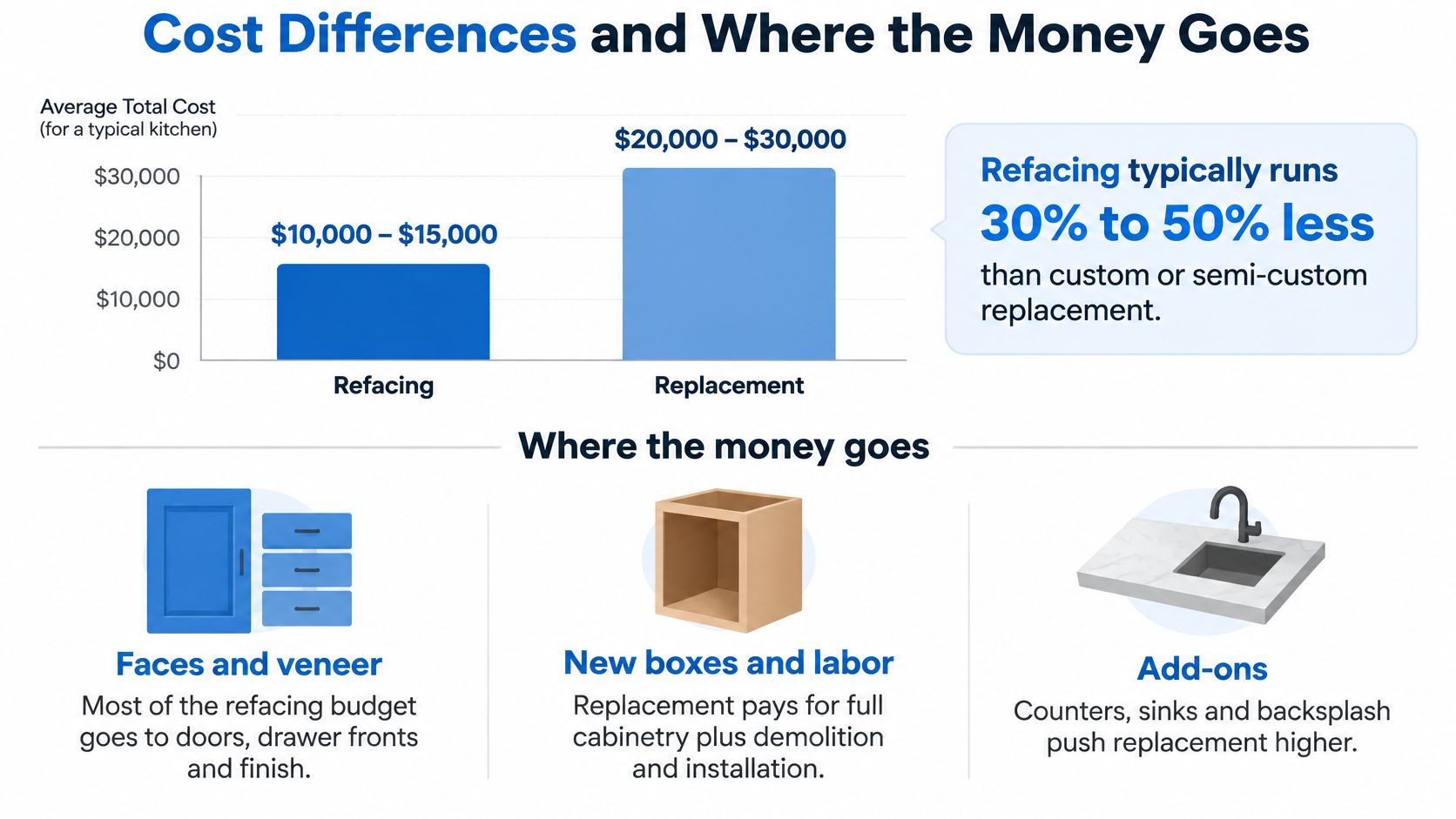
Start with the widest gap in the published numbers. A national consumer-cost comparison from Angi put average refacing at about $2,100 against approximately $6,400 for full replacement, with refacing generally landing 30% to 50% below the cost of replacing custom or semi-custom cabinetry.
Then the same reader finds a quote for refacing at nine thousand dollars and concludes the internet is broken. It isn't.
Why the published averages disagree
Scope, almost every time. One figure covers doors, veneer and labor on a small kitchen. Another wraps installation, countertops, a sink and a dishwasher into the total. In 2024, minor kitchen remodels had a median cost of $18,000, while major remodels involving replacement of all cabinets and appliances hit a median of $55,000, according to the Houzz Kitchen Trends Study as reported by Mayflower. Same room, same trade, very different projects.
| Source and year | Metric | Figure |
|---|---|---|
| N-Hance, 2025 | Median major kitchen remodel | $55,000 |
| N-Hance, 2025 | Median minor kitchen remodel | $20,000 |
| Houzz Kitchen Trends Study, 2024 (via Mayflower) | Median minor remodel | $18,000 |
| Zonda Cost vs. Value Report, 2025 (via Oakmoak) | Minor remodel cost nationally | $28,458 |
| Zonda Cost vs. Value Report, 2025 (via Oakmoak) | Resale value of minor remodel | $32,141 |
| Forbes Home, 2023 | Average cabinet replacement | $8,200 |
| Forbes Home, 2023 | Average cabinet refacing | $6,925 |
| Gaugius, 2024 | Average U.S. cabinet replacement | $5,000 |
| National consumer-cost comparison | Average refacing vs replacement | About $2,100 vs $6,400 |
The resale line matters more than the sticker line for a lot of households. In that 2025 cost-versus-value data, a minor remodel returned more in resale value than it cost, which is the case for refacing a sound kitchen and against gutting one that only needed a face.
What actually drives the quote
- Door count and style. A flat slab in a stock color is one price; a shaker with a routed profile in a custom paint is another.
- Veneer or laminate grade. Cheap laminate delaminates at the edges within a few years. It's the wrong place to save.
- Hardware tier. Soft-close hinges and full-extension slides are the difference between a kitchen that feels new and one that feels repainted.
- Fillers and toe kicks. Small line items that add up across a long run.
- Repair labor. The hours spent sistering a rotten sink base, shimming a sagging run, or rehanging a door that never sat right.
- Layout changes, replacement only. Moving a sink, a range or a hood means plumbing and electrical, and that's a different budget entirely.
Before you compare cabinet quotes, it helps to know what the rest of the room will take. Our breakdown of what a kitchen remodel costs puts cabinetry in context with counters, flooring and labor.
Set a ceiling before you shop, then ask a harder question: does the scope fit inside it without deferring the box repairs or the hardware that decide how the kitchen performs? Deferring those is how a cheap project becomes an expensive one.
Timeline, Disruption and Waste Compared
Refacing runs in four phases, and the longest one happens before anyone touches the kitchen. Faces get measured and doors and veneer get ordered; then doors and hardware come off; then new faces go on with hinges and fillers; then hinges get adjusted and edges sealed. Measuring and ordering is the wait, because the material has to land before site work starts.
Replacement adds design and manufacturing lead time at the front, then demolition, then setting new boxes level and plumb, then counters and trim before the room is usable again. Ask for the expected order date and delivery window in writing. A six-week promise made in March isn't the same promise made in October.
| Phase | Refacing | Full replacement |
|---|---|---|
| Measuring and ordering | Measure faces, order doors and veneer, about 1 week | Finalize layout, order boxes, 4 to 8 weeks |
| Demolition and removal | Strip doors and hardware, about 1 day | Strip old boxes and haul debris, 1 to 3 days |
| Installation | Apply veneer and hang faces, 2 to 4 days | Set boxes level and plumb, 3 to 5 days |
| Countertops and trim | Usually not needed | Template, fabricate and set counters, 1 to 3 weeks |
| Finishing and adjustments | Adjust hinges and seal edges, 1 to 2 days | Adjust doors, seal and finish, 1 to 3 days |
| Typical time on site | About 1 to 2 weeks | About 3 to 8 weeks including lead time |
| Waste produced | Doors, veneer scraps and hardware | The entire box set plus packaging |
What decides the disruption: the sink. Refacing usually keeps it in place, so a household can wash up elsewhere and cook from a temporary setup. Replacement takes it out, along with the range.
Schedules slip at three points: the countertop template, appliance delivery, and plumbing reconnection. Check whether each one sits inside the quoted window, and run the whole sequence against our kitchen remodel checklist before signing anything.
Design Flexibility and Finish Materials
Refacing changes the face of the kitchen and nothing else. Door style, color, panel profile, handle pattern, all yours to change. Box depths, cabinet heights and the run of the room stay exactly where the builder put them.
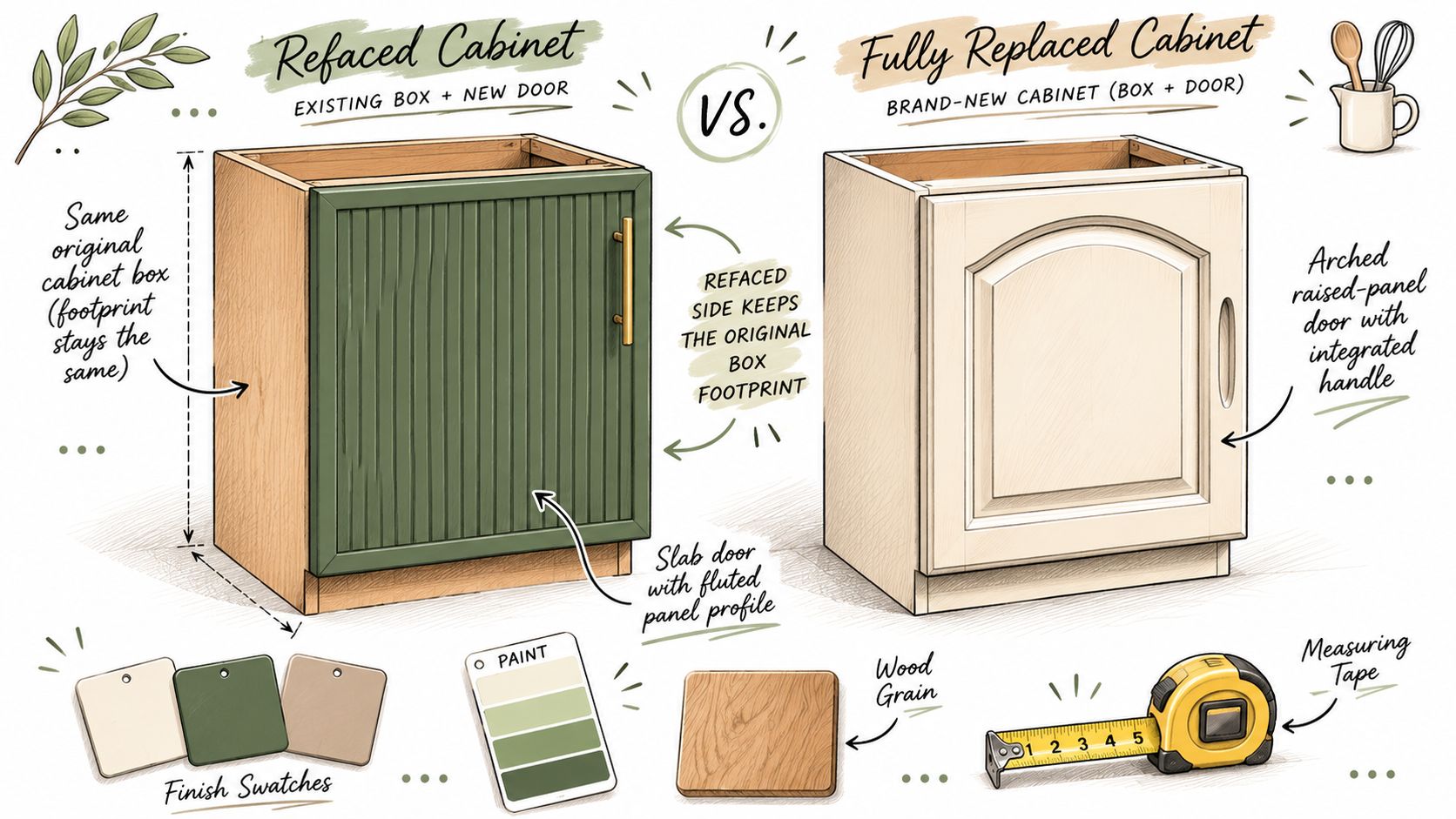
Replacement opens the design: taller uppers that use the wall space above the fridge, deeper base drawers, pull-outs, an appliance garage, a full-height pantry. If the current kitchen has a cabinet nobody can reach without a step stool, refacing keeps that problem and gives it nicer doors.
Inside refacing, the face material decides how the kitchen ages.
| Material | Moisture and heat | Scratch and repair | Best use |
|---|---|---|---|
| Rigid thermofoil | Fine in dry areas; can peel near heat or a wet sink base | Dents show; hard to repair | Budget cosmetic refresh in low-traffic kitchens |
| Laminate (PVC or melamine) | Moderate; sealed edges are critical | Scratches show; panels can be replaced | Durable everyday kitchens |
| Wood veneer | Good when sealed; sensitive to standing water | Refinishable; repairs possible | Premium look with long-term repair options |
| Painted or lacquered MDF | Fair; depends on the sealed finish | Chips can be touched up | Custom colors and modern slab styles |
| Solid wood doors (replacement) | Good with a proper finish; moves with humidity | Refinishable | High-end rebuilds and custom sizes |
New doors have to match existing box dimensions and reveal spacing, and any added cabinet has to line up in depth and finish with the refaced run. Get a drawing first. Epic Remodeling's preconstruction design includes interior and exterior floor plans and 3D visualization renderings, which is the cheapest way to compare a refaced elevation against a new layout before a single door gets ordered.
The test is simple. Want a new look on the same footprint, reface. Want a new footprint, replace. For more on pulling a palette together, see these design tips for kitchens.
Kitchen Conditions and Hybrid Scopes
The binary framing is the part that misleads people. The 2025 U.S. Houzz Kitchen Trends Study found that 69% of renovating homeowners replaced all cabinets while 27% pursued partial cabinet projects. Among the partial group, 55% chose exterior refinishing, 27% added some cabinets, and 25% replaced some, while interior refinishing rose four percentage points to 17%.
Read those together and the middle path stops looking like a compromise. It's what a large share of kitchens need, and the same study notes a 10% year-over-year rise in median spending on major kitchen remodels, reaching $60,000.
What the boxes tell you
Open a door, press the bottom panel of the sink base, and look at the joints. Rigid joints, flat panels and mounting points that still hold a screw mean the box has value worth keeping. Swelling under the sink, racked frames, a floor that has settled, or a box that has gone out of square all point the other way, because new doors will not hang straight on a crooked carcass no matter how carefully they're set.
| Kitchen condition | Points to | Why |
|---|---|---|
| Sound boxes with rigid joints and solid mounting points | Refacing | The box value stays; only faces change |
| Working layout with adequate storage | Refacing | No plumbing or appliance moves needed |
| Swollen sink-base panels from leaks | Repair or replace boxes first | Veneer over water damage fails |
| Out-of-square boxes or a sagging floor | Replacement | New doors won't align on a bad box |
| Moving the sink, range or plumbing | Replacement | A layout change needs new boxes |
| Needing much more storage | Replacement or added cabinets | Refacing doesn't add capacity |
| Sound perimeter, damaged island or peninsula | Hybrid: reface the perimeter, replace the island | Matches how partial projects usually run |
When the layout is the real problem
Moving a sink, relocating a range, adding a pantry, or widening a walkway means the boxes change, and refacing never changes boxes. This is the one question to answer before price. If the answer is yes, the refacing quote is a nice document that describes work you can't use.
The hybrid nobody quotes you for
Reface the visible perimeter. Replace the island that was built too deep for the room or the peninsula with the swollen base. Add a tall cabinet where the kitchen never had one. That scope solves the underlying problems and leaves the sound boxes alone.
The coordination is where hybrids live or die. Do new doors match existing dimensions? Do added cabinets align in depth and finish with the refaced run? Who sequences the countertop template around the new cabinet, and who owns the filler changes? We assign a dedicated project manager who supervises and assists from the start of the project through completion, which is the difference between a hybrid scope that lands and three trades waiting on each other.
Choose Refacing or Replacing for Your Kitchen
A 2025 study on circular kitchen design found that built-in furniture is discarded after seven years on average, well below its expected lifespan, and estimated that premature replacement can account for up to 57% of the climate impact of interior alterations and apartment maintenance over 15 years, with a full kitchen renovation involving built-in furniture and major appliances producing about 2.4 tonnes of CO2 (Chalmers circular kitchen design research).
That reframes the whole argument. The better choice isn't automatically the one that keeps the boxes. It's the one that doesn't get torn out again in five years.
- Reface when the boxes are rigid, dry and in the right place, the layout works, and budget or schedule is the binding constraint.
- Replace when layout, storage, cabinet depth or box condition is the problem, or when a refacing job would need the same sink-base rebuild anyway.
- Hybrid when the problems are local: a bad island, one rotten base, a storage gap.
Ask two more questions before signing. Can the doors and hardware be repaired rather than thrown away, and where do the removed boxes go? Refacing doesn't reset the age of a thirty-year-old box, and a layout you dislike will still be a layout you dislike with a nicer finish on it.
Then walk the kitchen with a qualified contractor who checks the sink base, the box joints, the floor, door clearances and the storage count. Request written line-item proposals with exclusions spelled out, and choose the one that answers the layout question rather than the lowest total.
Epic Remodeling offers a free in-home consultation performed by a qualified general contractor who helps plan the project, whether that ends up being a reface on sound boxes or a full rebuild when the layout is the problem. You'll get a complimentary estimate covering all labor and materials, with a clear scope rather than a number to compare against nothing. Book the consultation through the contact form or by phone, and visit Epic Remodeling to start with a walkthrough of your kitchen.