Home Addition Contractors: Hire Without the Horror Stories
Find, vet and hire home addition contractors the smart way: license checks, bid comparisons, permit timing and a contract you can trust.

Three bids are sitting on your kitchen table. Two look roughly alike. The third is meaningfully lower, and the contractor who sent it called you back the same afternoon, which your brain has already filed under "responsive."
That lower number usually isn't a discount. It's a set of decisions somebody will make later, on your dime: allowances set too low, exclusions nobody mentioned, inspections nobody scheduled, and however many change orders it takes to close the gap. A bid is a risk document with a price at the bottom. Read it that way and most of the hiring decision makes itself.
That's the whole method. Plan the hiring before you search. Check credentials before you fall in love with a layout. Compare scope and schedule before you compare totals. Do it in that order and the horror stories stay other people's stories.
Map the Hiring Process Before You Search
The pattern is predictable. A homeowner signs the lowest bid, which is a one-page proposal with a total and a start date, and six months later the addition is framed and sheathed with no roof, no windows, and no permit card in the window. The builder isn't necessarily dishonest. Nobody wrote down the sequence, so nobody owned it.
Hiring home addition contractors runs in six phases, and each one produces a document you keep. Skip a phase and the next one costs more.
Demand isn't what's holding you up. The 2023 American Housing Survey, administered by the U.S. Census Bureau and the Department of Housing and Urban Development, found that 51.6 million homeowners, or 59% of homeowners, made improvements during 2021 to 2023, with total homeowner spending of $827 billion and median spending of $6,500 per homeowner. Firms that build additions well are booked out, so an open calendar in spring is worth a question, not a celebration.
| Phase | What you do | What you should have before moving on |
|---|---|---|
| Define scope and budget | Sketch the room, its function and your ceiling | A one-page scope with size, use and a budget you won't exceed |
| Build a shortlist | Collect referrals, permit records and reviews | Three to five contractors who build additions specifically |
| Verify credentials | Check license, insurance and past work | A verified license, a current insurance certificate and two references |
| Compare bids | Review line items, allowances and exclusions | A side-by-side comparison of scope, not just totals |
| Sign the contract | Confirm permit, schedule and change-order terms | A written contract with milestone dates and a change-order procedure |
| Oversee the build | Track inspections, updates and approvals | Signed change orders, passed inspections and a final sign-off |
The page that makes every bid comparable
Phase one does the heavy lifting, which is why it's the phase homeowners rush. One page: the room's size, what it's for, and the number you won't exceed. Every bid you receive is priced against that page. A vague scope produces bids that can't be compared, and in that fog the cheapest number always wins by default.
If you're still deciding what the space should be, work through home addition ideas with pictures before you interview anyone. Images settle family arguments faster than a floor plan does.
Written scope first, calls second. A contractor who asks your budget before asking what the room is for is pricing a wish, not a project.
Get that page on paper this week, then pick up the phone.
Find Local Contractors Who Build Additions
Four sources beat a search results page.
- Neighbors with a finished addition. Someone within a few streets who completed one in the last three years can tell you what the crew was like in week nine, which is the part no website covers.
- City and county permit records. These list recent additions by address and often by contractor name. A firm appearing repeatedly in your zip code already knows your inspectors.
- Licensed contractor directories. Useful for the license lookup, not for discovery. More on that below.
- Reviews read for detail. Skip the star average. Look for sentences about schedule slips, site cleanup, and change orders, because those are the three things that go wrong.
Then narrow to firms that name additions, ADUs, or structural work on their own site. A kitchen-only remodeler can be excellent and still be the wrong hire here, because framing, foundation, roof tie-in, and exterior envelope work are different trades with different liabilities. Contractors who work across Orange County home remodeling and Los Angeles County tie new square footage into stucco, rooflines, and sixty-year-old framing every month, and their portfolio should show that seam.

Ask these five on the first call, in this order.
- How many additions did you finish last year? Not remodels. Additions. A number under three tells you where you'd sit on their attention list.
- Who runs my site day to day, and is that person here every week? A name, not a department.
- Do you pull permits in your own name? Owners who borrow another license are telling you something about their insurance and their margins.
- What's your typical span from permit approval to final inspection? Anyone who answers in days hasn't done this recently.
- Can I speak with a client whose addition finished in the past year? Within twelve months, so the details are still fresh.
Question two is not small talk. Construction management is a full occupation: the U.S. Bureau of Labor Statistics counted about 303,220 construction-manager jobs in May 2022, at a mean annual wage of $112,790, including roughly 52,400 in residential building construction. Whether the person answering that call is a site superintendent or an owner juggling four jobs decides how fast your framing inspection gets scheduled.
Say a homeowner in Irvine starts with twelve names from a permit search and a neighborhood group chat. Two calls in, the list is four: one firm couldn't name a single addition finished last year, another had a relative pulling permits under a different license. Both discoveries cost nothing on the phone and a fortune on day forty.
Five names is the ceiling when you move to verification. Longer lists push you toward whichever bid is lowest rather than whichever firm you checked.
Verify Licenses, Insurance and Past Work
Every contractor you call will say some version of "we're licensed and insured." That's a claim, not a fact, and checking it takes about four minutes per firm.
| Criterion | Where to check | Red flag |
|---|---|---|
| State contractor license | State license board lookup by business name or license number | Expired or suspended license, name mismatch, or no license for the trade |
| Liability and workers' comp insurance | Certificate sent directly from the insurer | Certificate that is out of date, forwarded by the contractor, or refused |
| Past addition work | Visit or call two finished additions | Owner unwilling to show the work or name a client |
| Local permit history | City or county permit search for past projects | Permits pulled only when the inspector asks for them |
| Written estimate | Line-item bid with allowances and exclusions | Lump sum with no detail or a verbal-only quote |
The license check most homeowners skip
Match the business name on the bid to the name on the board record, not just the number. Confirm the classification covers structural and framing work, because a license can be active and still not cover what you're hiring for. Check the status line, including whether workers' compensation is on file. A license with no coverage listed is a question worth asking before it becomes yours.
Insurance has exactly one rule
The certificate comes from the insurer, not from a forward in the contractor's email. General liability and workers' compensation both, and if subcontractors are on the job, their certificates too. An uninsured framing crew hurt on your property is a claim attached to your homeowner policy, and your insurer will go looking for the general contractor's coverage first.
Past work, in person
Visit a finished addition and ask the owner two questions that get past taste in tile: how often were change orders written, and did the crew leave the site secure and clean each day. Somebody who won't arrange a visit, or won't name a client from a completed addition, has already answered.
A permit history that starts and stops with the jobs where an inspector came knocking tells you how the next one will go.
Passing all five checks doesn't make a firm a sure thing. Failing one makes it a sure problem.
Credentials are checkable. Epic Remodeling is licensed and insured, CSLB # 1095347, and that number is worth typing into the board's lookup yourself rather than reading it off a business card.
Work the table row by row. When you're finished you should have three contractors left and a folder holding each one's license printout, insurance certificate, and two reference names. That folder is what you carry into the site visits.
Book Two Site Visits This Week
Two names, two visits, same week. Momentum matters: a shortlist that sits for a month becomes a decision made on price alone.
A real consultation is a walk of the actual site, not a slide deck. At Epic Remodeling the free in-home consultation is performed by a qualified general contractor who helps plan the project, and it can be booked through the contact form or by calling 949-594-6444. Ask for the complimentary labor and materials estimate, and ask which dedicated project manager will own your job from kickoff to the final walk-through.
What to carry:
- Your one-page scope, sized and budgeted.
- A lot survey or site photos, so setbacks get discussed instead of discovered.
- The bid comparison sheet, if numbers already exist.
- A written list of license, insurance and permit questions, because you'll forget two of them in the driveway.
After each visit, note who answered the project-manager question without hesitating, who described the permit sequence from memory, and who told you something you didn't want to hear. The third one is usually your contractor.
Sign nothing until the license check, the permit matrix, and the change-order clause are all in writing.
Compare Bids Without Falling for the Lowest Number
Two bids. One says $148,000. The other says $136,000, and that $12,000 gap is why most homeowners sign the second one. Now open them both. Bid B carries a $6,000 cabinet allowance where Bid A carries $14,000, and B excludes permit fees of about $3,000 and yard restoration of $1,500. Add those back and the discount has become a $500 premium, before a single change order.
That isn't a trick of arithmetic. It's the normal structure of a bid written to win a comparison instead of to build an addition.
| Bid format | What it shows | Hidden risk |
|---|---|---|
| Line-item bid | Each trade, material and allowance listed | Allowances may understate real selection costs |
| Lump-sum bid | A single total for the whole job | Scope gaps are hard to see |
| Labor-and-material inclusive bid | Labor and materials bundled in one figure | Exclusions and change-order rates may go unstated |
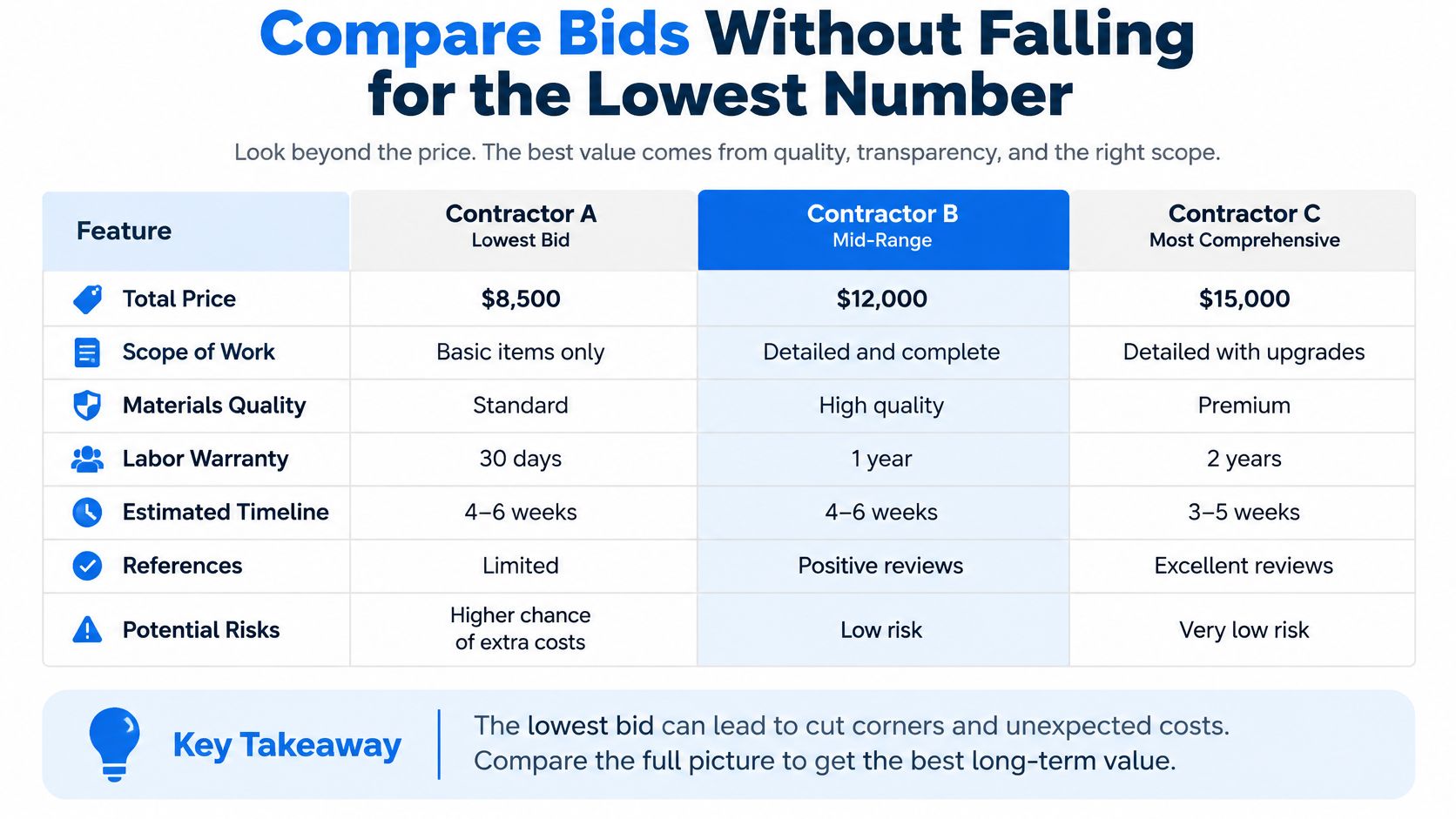
Run four lines on both bids before you choose.
- Allowances. Cabinets, tile, plumbing fixtures and lighting are where allowances hide. Compare each allowance against what your actual selections cost, because a $6,000 cabinet allowance doesn't buy a kitchen.
- Exclusions. Permit fees, engineering stamps, utility upgrades, dumpsters, yard repair. Ask for the exclusions page in writing; it's the most-skipped page in the packet.
- Change orders. Ask how many were written on the last three jobs and who signs them. A firm writing forty change orders on a room addition has a pricing problem dressed as a scope problem.
- Payment schedule. Draws follow completed work and passed inspections, and the deposit stays small enough that your exposure is modest if the work stops.
The funding check comes before the price check
Money decides which bid you can carry. A survey of 52 Los Angeles County homeowners who had already built ADUs found that 58% named financing as an obstacle, 73% refinanced their primary residence and 50% used cash savings, and none reported using a bank construction loan. The sample is small and the lesson holds: settle how you're paying, including contingency and interest during construction, before you compare prices. For an ADU, test projected rent against the loan payment before you sign anything.
Read the schedule behind the number
Then ask what the number is attached to. The U.S. Government Accountability Office's schedule-assessment guidance names incomplete design as the largest risk driver in its house-construction example, followed by material availability, and recommends assigning each risk to a specific activity and simulating its effect instead of relying on a promised completion date. Translated to a bid: the contractor who has already frozen window, door, cabinetry and HVAC selections, and named approved alternates for long-lead materials, is quoting a schedule. The one offering a single finish date is quoting a hope.
If you want a sanity check on the total before you sign, run your figures through a room addition cost calculator so each bid gets compared to a realistic range rather than to its competitor.
Compare scope first, schedule second, price third. Price is the last thing you check, never the first thing you trust.
Lock In Permits and a Schedule You Can Trust
Permits are the quality-control record of the entire project, and they're the part homeowners file under paperwork. The U.S. Department of Energy's compliance study notes that renovation activity is hard to evaluate precisely because many homeowners and contractors don't obtain permits, and one dataset it cites contained only 6% renovation permits. That gap surfaces at resale, at inspection, and at the moment a wall has to come open to show work that should have been photographed the first time.
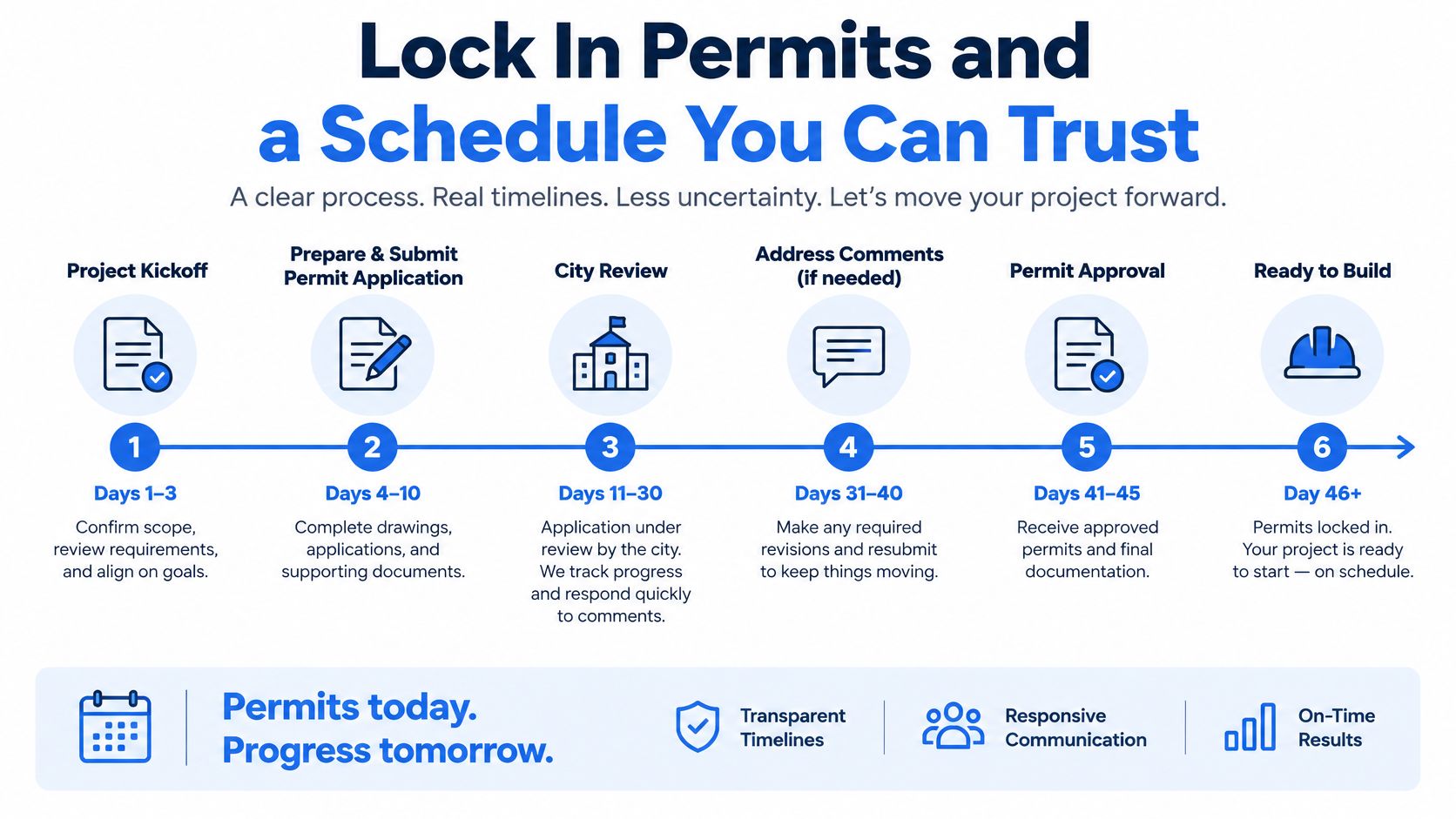
Six controls belong in the contract, not in a conversation.
- Get the permit matrix in writing. One page listing the drawings, engineering, agency reviews, inspections and closeout documents your city requires for your scope. A contractor who can't produce it in a day hasn't built in your jurisdiction lately.
- Name the permit holder. Who signs the application, who pays the fees, who meets the inspector. "We'll handle it" is not a name.
- Turn inspections into hold points. Foundation, framing, rough plumbing, rough electrical, insulation, final. No trade covers another's work before its inspection passes, and that rule lives on the schedule, not in conversation.
- Photograph concealed work. Framing, plumbing, electrical, flashing and insulation, before drywall closes over them. Those photos outrank any receipt the day a buyer or an adjuster asks what's inside the wall.
- Tie draws to inspections. Release each payment when the matching inspection passes, and hold the final draw until final sign-off and the punch list are closed.
- Set the update rhythm and the escalation path. Same day each week, covering critical-path items, pending decisions and what's waiting on the city.
A permit isn't red tape. It's the only independent record that the work behind your drywall was inspected.
Labor is the other schedule risk, and it isn't personal. A 2025 AGC/NCCER survey of nearly 1,400 construction firms reported by Commerce Bank found that 92% struggled to fill open positions and nearly half had experienced job delays as a result. Ask which crews will be on your site each week and what the backup plan is when one of them gets stretched.
Demand a completion range rather than a date. A real schedule shows inspection holds, weather allowances, and the two or three activities most likely to slide onto the critical path, plus who is watching each of them.
Your contract should name the permit holder, list the inspection sequence, and describe the change-order procedure in a paragraph you can read out loud. Miss any of the three and you aren't signing a contract yet. You're signing an estimate.
Epic Remodeling builds room additions, ADUs, and whole-home renovations across Orange County, Los Angeles County, the Inland Empire, and Riverside County, with a dedicated project manager supervising from kickoff through final inspection and a written scope you can compare line by line before you commit. Book the free in-home consultation and you'll walk the site with a qualified general contractor, get a complimentary labor and materials estimate, and have the permit and schedule questions answered while you're still deciding. Visit Epic Remodeling or call 949-594-6444 to put your addition on a real schedule.